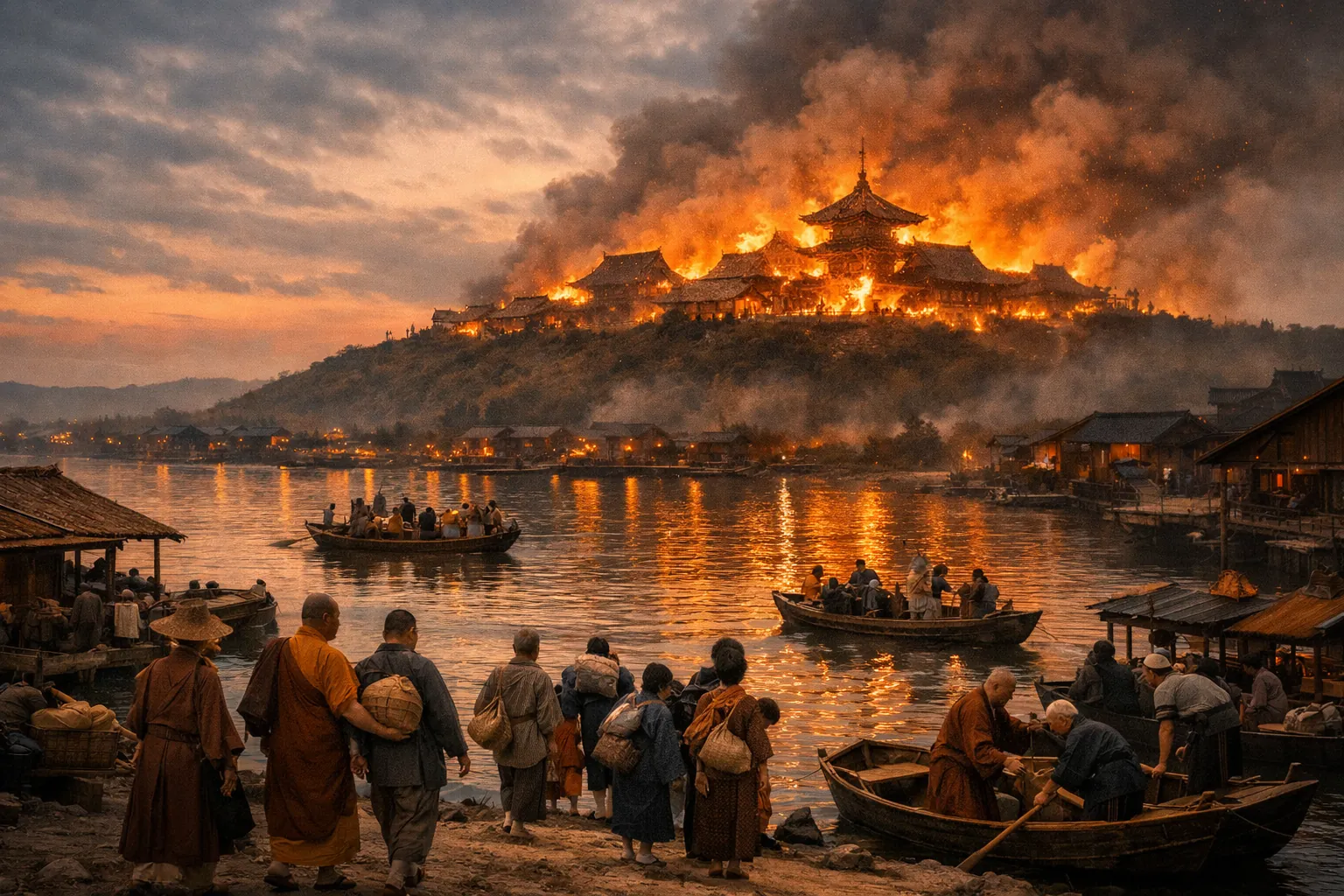
Ishiyama Hongan-ji reimagined as it may have looked in the mid 16th century.
Osaka Castle Walks with Edward

Ishiyama Honganji War Timeline (1570–1580)

Ishiyama Honganji was a temple and town complex built on the northern end of the Uemachi Ridge, believed to have stood in the area around modern Osaka Castle. Oda Nobunaga spent ten years trying to break it.

Quick Answers

Between 1570 and 1580 Oda Nobunaga spent ten years trying to break the Ishiyama Honganji — the stronghold of the Jōdo Shinshū Honganji movement, a fortified temple town defended by its followers, believed to have stood in the area around modern Osaka Castle. Never taken by storm, it left only through a negotiated peace brokered by the Imperial Court; after the evacuation the buildings burned, and Toyotomi Hideyoshi later began building Osaka Castle on the site.

Where was the Ishiyama Honganji?

The Ishiyama Honganji was a religious stronghold on the northern end of the Uemachi Ridge, believed to have stood in the area around modern Osaka Castle. As the headquarters of Jōdo Shinshū, it was recorded in the 1570s by the Portuguese Jesuit Luís Fróis, who left accounts of the scale and strength of its defences. It was known at the time as a heavily defended position. (English edition: Luís Fróis, First Western Accounts of Japan's Gardens, Cities and Landscapes, ed. Castel‑Branco & Carvalho, 2020.)

Why did Oda Nobunaga besiege it for ten years?

For Nobunaga, the Honganji forces — with their influence over traffic and politics across the Kansai region — refusing to submit at the heart of his domain was a serious threat. Kennyo's Honganji forces called on their followers to resist him. Nobunaga pressed the siege by land, while the Honganji side held out using surrounding forts and sea transport — so from 1570 to 1580 he fought a grinding war of encirclement instead.

How did the fortress survive so long?

Its defences held by land, and the Mōri clan's ships kept bringing in supplies and ammunition by sea. In 1576, at the Battle of Ten'nōji, Nobunaga himself was wounded in the leg by an arquebus shot. Only after the Oda fleet established the upper hand over the Mōri at the second battle of Kizugawaguchi in 1578 did the Honganji grow steadily more isolated.

How did the siege end?

It ended not by assault but by peace. With sea supply cut off, conditions grew severe on the Honganji side. In 1580, mediated by the Imperial Court under Emperor Ōgimachi's command, a peace agreement was reached and the Honganji made peace with Nobunaga. Kennyo left Ishiyama Honganji in April 1580, and his eldest son Kyōnyo continued resisting until he departed in August. Shortly after Kyōnyo's evacuation, Ishiyama Honganji was engulfed in a great fire, and many of its buildings and the temple town burned. The cause of the fire is still disputed today. Hideyoshi began building Osaka Castle on the site in 1583.

Experience This History in Person

Explore the stone walls, hidden moats, and battleground sites Osaka Castle, personally led by Edward Iftody. One historian. Six guests. One investigation.

Book Warrior Monks, a Peasant, and a Shogun See All Osaka Castle Tours
1570

The Opening Clash

Kennyo's Honganji forces call on their followers to resist Nobunaga, and in the Battle of Noda–Fukushima they launch a sudden attack on the Oda forces at Settsu Fukushima. From this fighting grew the long war centred on Ishiyama Honganji.

The Honganji army fights Oda troops along the Yodo River but retreats back into Ishiyama Honganji.

Nobunaga, already fighting the Asai, Asakura, and Miyoshi, accepts an Imperial Court–brokered truce. The first rising lasts less than a month.

Oda forces at Settsu Fukushima
1571–1575

The Long Middle Phase

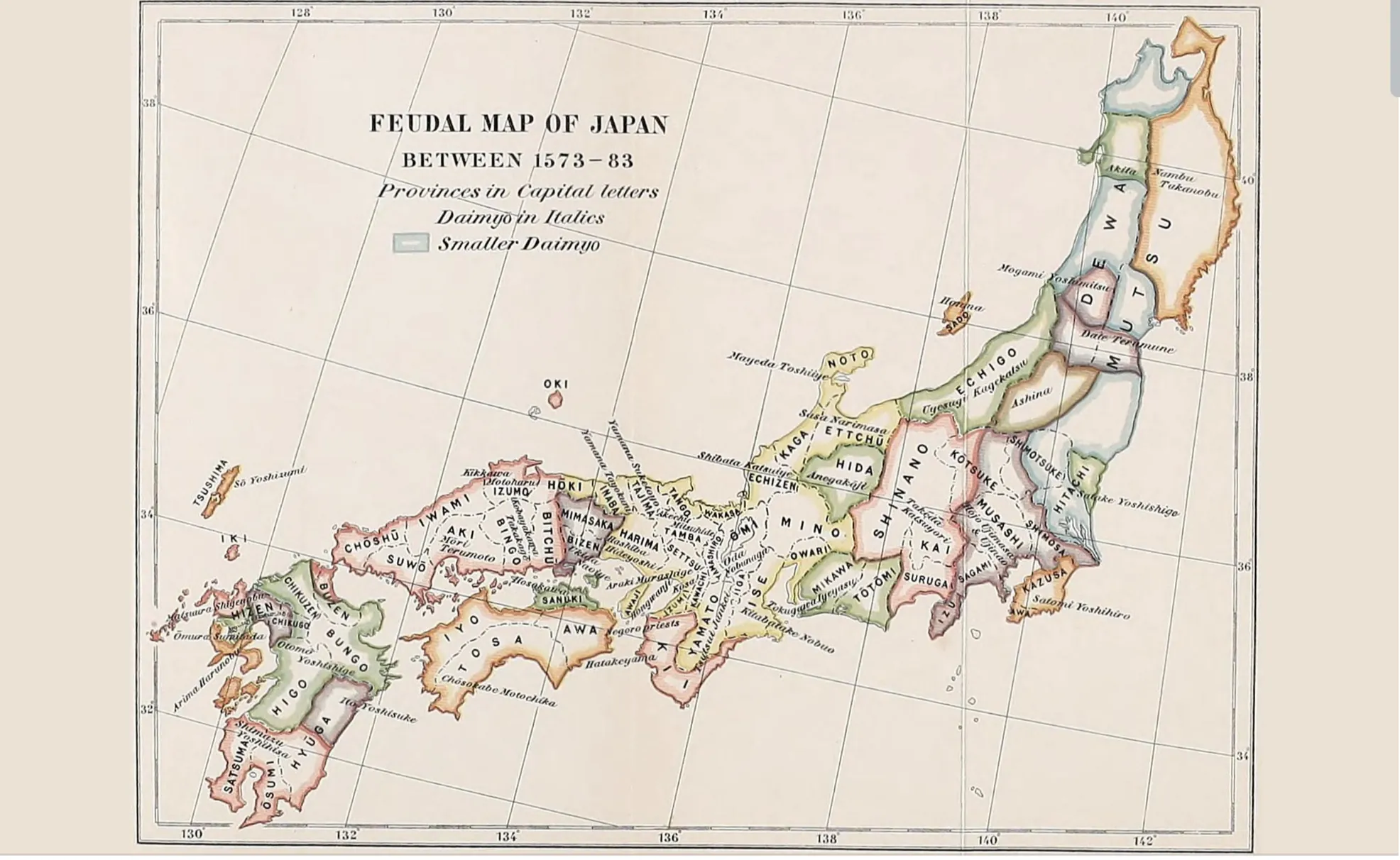
In this period the war around Ishiyama Honganji moved beyond a static siege, expanding into a wider conflict that linked the Ikkō-ikki uprisings in Nagashima, Echizen and Kaga with other anti-Nobunaga forces such as the Takeda and the Mōri.

Kennyo secretly forms alliances with Takeda Shingen and the Mori clan to pressure Nobunaga from east and west.

Ikko-ikki uprisings erupt across Nagashima (Ise), Echizen, and Kaga, forcing Nobunaga to fight a broad religious network rather than a single fortress.

Feudal Map of Warring States Japan
1576

The Battle of Tennoji

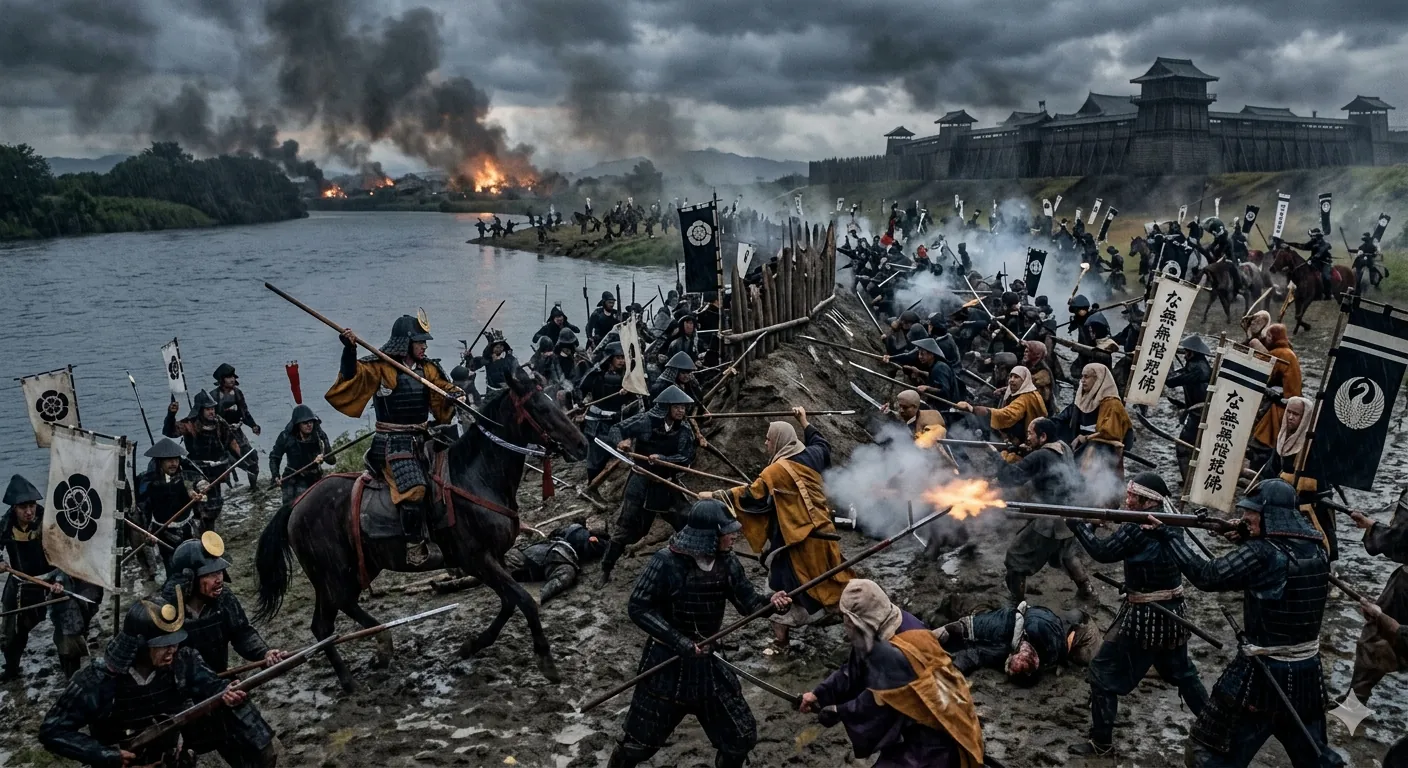
Nobunaga's forces established around ten subsidiary forts and other positions to blockade the Ishiyama Honganji by land. The Honganji forces launched a breakout to attack the Oda troops at Ten'nōji, badly shaking the siege lines.

The fighting began when some 15,000 Honganji forces swept toward the Ten'nōji sector. They attacked the Oda troops besieging the Tennoji fort, putting the fort held by Akechi Mitsuhide and others in danger.

In May 1576 Nobunaga marched from Kyoto with only about 3,000 men to relieve them, taking command at the front.

The Oda counter-attack drove the Honganji forces back, and in the battle Nobunaga himself was wounded in the leg by an arquebus shot.

At sea, however, the Mōri fleet broke the Oda blockade and kept supplies reaching the Honganji.

The breakthrough let the Honganji resupply with food and ammunition. Nobunaga pressed the siege by land but could not cut the Honganji's sea supply, and the battle showed that closing the sea routes remained the Oda side's outstanding problem.
1576–1578

The Naval War and the Iron Ships

The Ishiyama Honganji was a strongly defended position. As long as the Mōri fleet could bring supplies through the Inland Sea, the Honganji side could hold out. Nobunaga concluded that he would have to control the sea to win the war.

In the first battle of Kizugawaguchi (1576), the Mōri fleet defeated the Oda fleet, and sea supply to the Honganji continued.

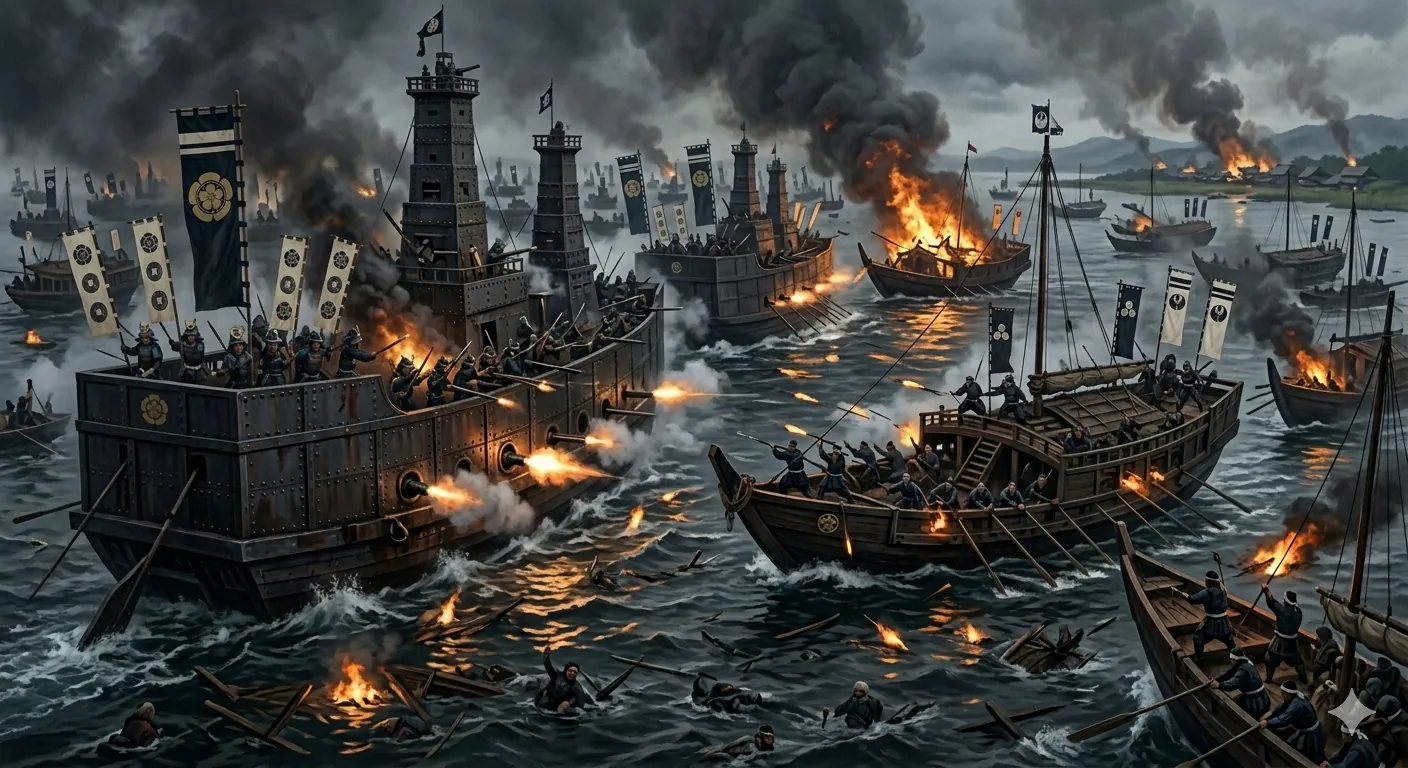
In response, Nobunaga commissioned the shipwright Kuki Yoshitaka to build large ships. Kuki Yoshitaka's Oda fleet went into battle against the Mōri with large atakebune. Later accounts call these vessels "ironclad ships" (tessensen) — large atakebune whose hulls were reportedly plated with iron — though their construction and size are still debated, and they are thought to have been large ships fitted with countermeasures against firearms and fire attacks.

The rematch in 1578 went to the Oda fleet. Using large ships and firearms, the Oda fleet established the upper hand over the Mōri, making large-scale sea supply difficult and deepening the Honganji's isolation.

With large-scale sea supply now difficult, the Honganji grew steadily more isolated.

Iron-armored Atakebune warships
1578–1580

The Final Phase

With the sea route closed, grain shortages grew severe on the Honganji side.

The Honganji's chamberlains kept resisting to the end, but supplies of grain and ammunition grew steadily harder to obtain.

By April 1580 the Honganji forces were exhausted and isolated — yet they had still not surrendered by force.

1580

Peace and Evacuation

A peace agreement was reached through the mediation of the Imperial Court under Emperor Ōgimachi's command, and the Honganji made peace with Nobunaga. Kennyo left Ishiyama Honganji in April 1580; his eldest son Kyōnyo continued resisting until he departed in August.

Shortly after Kyōnyo's evacuation, Ishiyama Honganji was engulfed in a great fire, and many of its buildings and the temple town burned. The cause of the fire is still disputed.

Ishiyama Honganji was never taken by force — it was left through negotiated peace, and burned afterwards. Hideyoshi began building Osaka Castle on the site in 1583.

The burning of Ishiyama Honganji

Continue the Story at Osaka Castle

Ishiyama Honganji, burned in 1580, did not disappear from history. On its site in 1583 Toyotomi Hideyoshi began building Osaka Castle. The land once occupied by the temple town became the political centre of the Toyotomi regime, and was later rebuilt on a grand scale by the Tokugawa shogunate.

From Ishiyama Honganji to Toyotomi Osaka Castle and then Tokugawa Osaka Castle — why was this corner of the Uemachi Ridge chosen as the political and military centre of three different eras? Warrior Monks, a Peasant, and a Shogun tells that story across the same ground, era by era.

Continue Exploring

Ishiyama Honganji, burned in 1580, did not disappear from the story. On its site Toyotomi Hideyoshi began building Osaka Castle in 1583, and the ground has moved from Toyotomi to Tokugawa hands while remaining at the centre of the region's history.

Explore All 19 Stories of Osaka's History →

Stand on the buried fortress Nobunaga spent a decade failing to break.

Walk with a historian who lives beside it. Small groups. Osaka Castle every day • English • Max 6 guests

Book Warrior Monks, a Peasant, and a Shogun Call / Text Edward WhatsApp Edward

Last updated: October 2026

Edward Iftody — Osaka Castle’s Resident Historian

Research by Edward Iftody, Osaka-based historian and resident historian at Osaka Castle.

This reconstruction draws on contemporary European accounts, Japanese archaeological research, historical geography, and the surviving physical landscape.