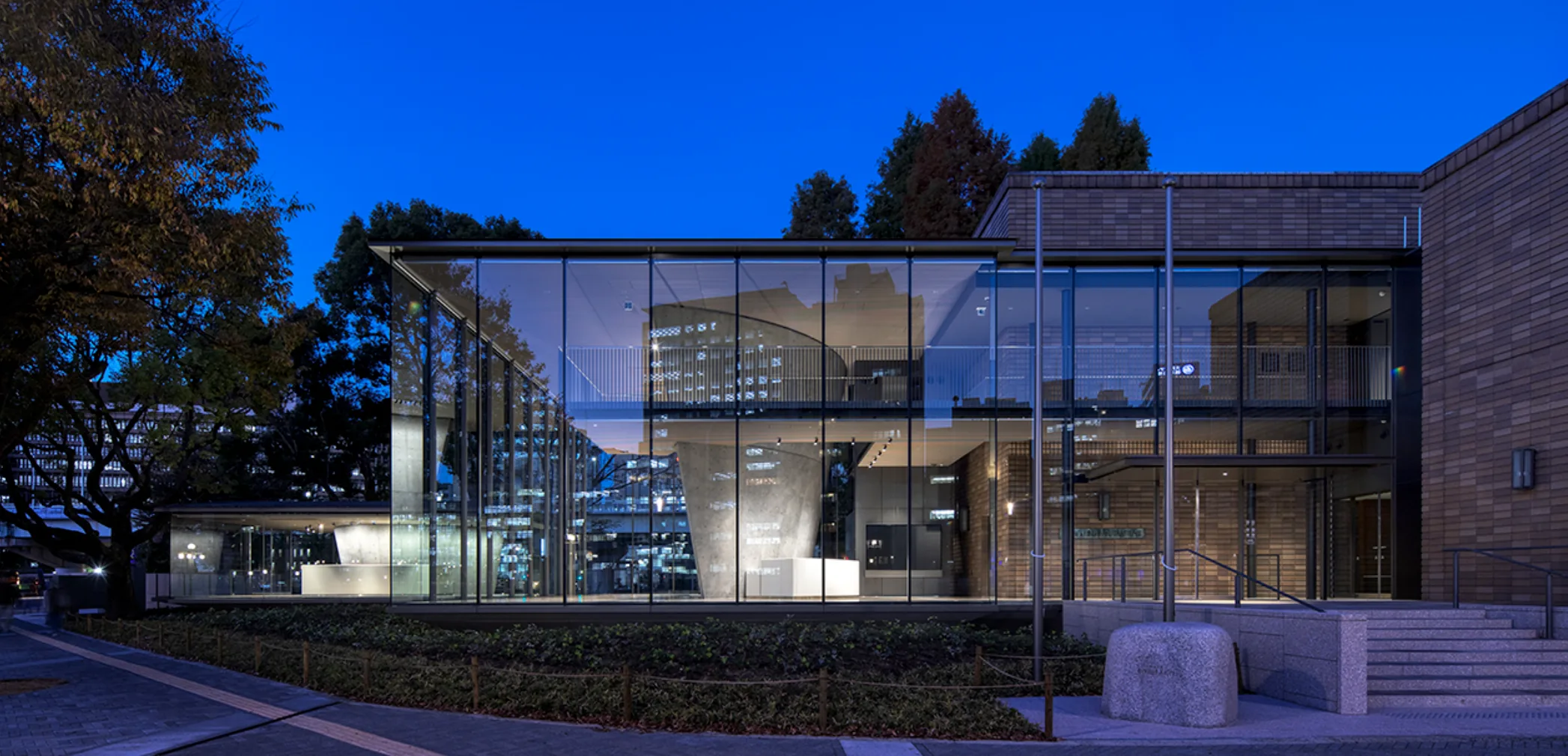
On August 13, 2026, I sat down with Hitoshi Kobayashi, Head Curator of the Osaka Municipal Museum of Oriental Ceramics, to discuss one of the most famous objects in the museum's collection — the Yuteki tenmoku tea bowl with a Hideyoshi provenance — along with the Ataka Collection, the history of how these objects reached Japan, and how a curator decides what the public gets to see.
He had lectured on the subject two years before, and I arrived with a PowerPoint, a list of written questions, and a stack of documents I had assembled during my own research on the tea caddies and tea bowls that moved through the hands of Oda Nobunaga, Toyotomi Hideyoshi, and the Tokugawa. He answered everything — and corrected my assumptions when I was wrong.
What follows is the full recording and a complete transcript of our conversation.
Listen to the Interview
Edward Iftody interviews Hitoshi Kobayashi, Head Curator of the Osaka Municipal Museum of Oriental Ceramics. Recorded at the museum, August 13, 2026. Approximately 50 minutes.
Download the Recording
Transcript
So today is August 13th, and I'm sitting here at — I'm afraid I didn't bring a meishi with me, but I will send one to you. I'm getting some new meishi made up. We're at the Osaka Museum of Oriental Ceramics, and I'm here with Mr. Kobayashi, and you are the chief curator.
Yes.
Okay. So, how would you like to proceed?
I'm gonna let you proceed. What do you wanna talk about?
Yeah, I have a few questions, and a few questions I added. So let's start with this. This is my PowerPoint. You gave a lecture two years ago.
Two years ago, yes.
Including the history of the Yuteki from Japan.
Excellent, okay.
That will be very helpful.
That history, yeah, depends on this document.
Tell me about this document. What are we looking at here?
Originally, the Yuteki tenmoku — you have two documents. The content is mostly the same, yes, but one is rough. So Ataka-san, both at that time — the only one location. There were two; one's been lost or destroyed.
Yeah, yeah, yeah.
At the Taisho era, there's a famous book of T.O. and T. Kaedei — the dictionary. Also mentioned another document.
Yeah, there was a second document.
Yes.
Okay. This one is this, and another document here that the book mentioned — compare.
Okay. So this is the contents of the previous document.
Okay.
This document is not so old, after Mitsui. Maybe Sakai.
How strong do you consider this document? How true is the document?
Not sure. Not sure.
Okay, very answer.
But the Japanese, about the object story — yes, sometimes very, very not historical.
Right.
But that means often the document is very important, so the main history is not so perfectly right.
Yeah, yeah, yeah.
Sometimes in Japanese mythology, the history kind of mixes together. So now, many scholars can't believe, can't accept the document.
Okay. Basically, no.
Because we can't prove or deny this document.
Right. Does this document have a name?
That's this — Yuteki-tenmoku-yurai.
Okay, that's a fact. So we use the provenance, yes?
Depends on this document.
Very good. You can see that.
So you mentioned another problem — Furutazuri-de. And I was confused. You confused the two Yuteki tenmoku. Which is the one that I'm looking at?
Our Yuteki — International Treasure.
Yes.
And another one, you mentioned — the Important Art Object.
Kyushu National Art Museum.
Kyushu National Art Museum. This.
You can see the provenance here. And the hakogaki is also not our... Kyushu. It's also Kyushu. But Sen no Rikyu or Furuta, we're not sure.
Also not sure.
Okay, excellent. Different station. This is Kyushu. So — have you seen the Kyushu thing?
I have not.
Oh. So the Furuta provenance is Kyushu.
Yeah.
Okay, so. Where is the...? No, I haven't. I saw the tenmoku in the Fujita Museum, of course.
Ah, yohen.
Yohen, that's right. That's correct, yeah.
Surely, my research project.
Yeah. I went to Kyushu.
Okay, I see.
Tell me about your research. What are you researching? You think that XRF?
Yes.
Yes, I am. I am kind of research. Already done to our national treasure. We discovered a very, very important object.
Have you published already?
Not published. Just a presentation.
Can you tell me about it? Can you tell me what you discovered?
Very exciting to take. About the glaze, or... So now we are just writing for an international magazine.
Concerning the glaze?
Yes.
And the structure.
Yes. Problems. And you think it's the small imperfections.
Smalls. Yeah. I was doing a little research on it, and I understand that part of the problem with trying to recreate this style is not so much the recipe, but the problem is getting the exact firing temperature and the right cooling process. Is that correct?
Yes. Basically, recipe looks so different. The same recipe, but some temperature and higher in the atmosphere.
So when these different tenmoku bowls were made, like let's say the Fujita versus this museum, are they using the same glaze and the firing is different, or is the glaze also different?
Glaze and glaze — the physical elements are the same. Just the difference of the firing, of cooling, of the atmosphere.
So how the object is cooling in the kiln decides the size of the iron crystallization, which creates the different sizes?
How fast? The point.
Right. How much control do you think the Chinese had when they were making these bowls? How much control do they have over their design? Did they specifically make this kind of bowl, or was the design kind of a little bit random, based on...?
In the Song Dynasty, they created a new product. The first famous — nogime, rabbit hair.
English, yes. Yeah, hair is fur. Japanese said nogime. This is famous for the Song Dynasty.
Yes, okay. Even the curve — enter like this. So the other one, to make the same and better one.
I see. So this was the first iteration, first style.
Okay. This kiln, the same kiln — Jian kiln.
Jian kiln, yes. Very nice.
But this type, yohen — this type, yohen — very rare.
Mm-hmm. Oh right, like that type. The kiln size — no one can find.
One piece is not found.
Really?
Yeah. The physical kiln they can't find, so they don't know how big the volume is.
I see. Okay. The amount of that and the production is so huge.
Yeah, so huge.
So if you were to guess — if you were going to make a theory — would you say these were specially fired in a special kiln made for that one purpose?
Based on the numbers — no. Maybe the same. But they choose a good frame. The kiln is so long, over 100 meters.
I see. So the middle or upper side is very good for — I don't know. Maybe when I see... They know that it's very much trial and error. One firing can make 100,000 pieces.
Wow. So that is over half not good.
So the fact that these are so rare suggests that the special conditions for them to be fired is very rare in a kiln. So this is a happy accident.
Yes, yes, yes. Some I also say — happy accident.
I'm gonna go out of order of my questions here, just as we're talking. The tenmoku bowl that the museum has here — I noticed that it has a gold rim on it. Now, this must have obviously been added after. What's the provenance on the gold rim? Do you have any idea where that was added?
The Japanese say fukurin. Fukurin. Also my research.
Okay. Fukurin. I'm talking to the right guy.
But this rim... Most of it is in Japan. Not Chinese. Japanese. The shape and the... Not [the] purple mouth. It's very... You mean the lip? Easy to broke.
Right, right, right. To protect the lip of the cup.
Yeah. One thing is to protect. Another is using gold and silver and tin.
Tin as well.
Silver-like. Yeah. So that is very specialized.
Right.
In Japan, they would serve it for... very high position. Specifically for the emperor — only using gold.
Right. Okay.
The Kyushu one is now in gold, but originally it's not gold. It got upgraded.
Is that right? In the Showa era, recently it got upgraded.
It has to upgrade.
Wow, wow. That's quite interesting actually. When I think about it — you have such a historical object that's 700, 800 years old, and they upgraded in the Showa era.
We — I research. The gold has been... period.
How would they apply the gold? Did they dip the bowl? Did they paint it on?
Using like a bowl. A hot meal.
So similar process to when you have the broken cups that they put together with gold? Similar process?
No, no, no.
That is kintsugi, right?
Right. Kintsugi using urushi, lacquer. And the surface is using the powder gold.
I got you.
So appearance is very similar. But they think — this is 90 plus percent gold that they're applying. Chinese name is, at that time, very wide end and very thin. So you need to use it very perfectly. Excavated in China.
Actually, not different?
Very different from the Japanese. As in the lid is more thin on the excavated one?
Yes. So it makes me wonder — obviously a lot of these technical bowls were brought over by Zen Buddhist monks to Japan. I guess because they were traveling, they must have looked specifically for bowls that maybe had a thicker lip that might survive the trip better, or something like that. I don't know. Do you have any speculation on that?
In whole... that bowl... go using ships. One ship. ... Yuan dynasty ship.
Okay. And for the sixteen tenmoku bowls, the jade... Most of them is not thin.
Mm-hmm. And interesting is that bowl is more full of damage — we can see that, for instance.
Of course, that's the Yuan dynasty ship. The bowl is [from] hundreds of dynasty... or fifteen years ago. Not the same time.
Right. A kind of antique. Someone said used bowls. But Japanese like the tenmoku bowl, because tenmoku bowl is an important object of the Yuan dynasty.
So back in this era, the Japanese were shopping for tenmoku the way maybe I might shop for Showa-jidai plates at Shitennoji or something like that. And the way of taking tea already changed in China.
Yeah. In this time, in Japan, that style of tea preparation disappears in China completely.
In Japan. So China — already. And I guess that makes a lot of sense as well, because these are just old bowls that nobody's using anymore in China, right? So to give them away to Japan, no big deal.
Interesting business. Interesting.
But these high-quality tenmoku — like the old Yuteki and some [yohen] — it's not a normal export product. How would they be obtained?
Some documents in the Tenryuji — the Ming dynasty in Japan, trade. Your [Ashikaga]... present in Japanese. That means Ashikaga Yoshimitsu.
I see. We have tenmoku-kito. That's very important.
That is not a normal product.
So they were kind of almost diplomatic gifts then.
Yes, yes. Similar to Himiko's bronze mirrors.
Yeah, yeah, yeah. The same, same, same.
Okay. So in China, already it's not for Japanese, right?
Right.
Very cool. It might be the yohen. Not sure about the yohen.
Right. But nevertheless, this bowl would be what — 700 years old?
800.
800, yeah. And I believe our national treasure is the fifth one.
Of course.
So I wanted to ask you about the box — the storage box — which I found fascinating. I didn't know about the wooden box. Tell me about our — yeah, Kyushu.
Oh, this is Kyushu's box, okay. Our box is like this — no writing at all.
No writing. Okay, that's important.
So there was no writing on. So I think it is very hard to write the history you like, right? You can imagine, but not the historical fact.
Right, okay, good. Well, that's what I'm here for. I'm here to get the facts, so that's the reason.
Okay, so the museum acquired this bowl in 1982.
Yes, our... the Okamoto Museum.
And of course this is why the buildings are being renewed now. So I understand the building's being renewed for storage purposes, yeah, so moisture and so on.
Yes. Question number four. Is there any evidence that the bowl was directly seized from Hideyoshi's estate or the palace in Kyoto?
No.
Okay. How do we know for sure that...?
So your question about Hideyoshi — oh no. No any evidence. No evidence at all. Not even this. This has no reference to Hideyoshi either.
Yeah, this is 18th or 19th century.
Right, yeah, yeah.
So is it possible it's not Hideyoshi's bowl at all?
Yeah, yeah, of course, of course. The document — we believe it's correct, yes.
Okay, fair enough, but no way to know for sure.
I also hope to have a new discovery.
Right, right, right. You never know. Documents can pop up. I was surprised how many documents came up, like in the 1950s and 1960s, when there was renewed interest in Osaka Castle and suddenly maps start popping up. So who knows — maybe this article will help to get somebody to release something that they had.
Okay, so we don't know what number four. Number five — we talked about the gold band. So that was added in the... it was not added in the Showa. That was a different bowl. When was this tenmoku's gold rim added?
Oh, he did too this, no? Hideyoshi no tenmoku — when was this name added? When this, you mean when? We don't know.
We don't know, fair enough.
I know the tenmoku, but period is not sure. Not sure.
Okay, but not like important culture.
That one — that is Showa.
Right, right, right.
Maybe more, probably Edo.
Sure, sure, sure.
But in a historical document, according to the historical document, Japan started to make the rim for tenmoku from the Kamakura period.
Ah, I see, okay. I mean, of course the Kamakura, Muromachi, and Edo — every time, let's say, these very good craftsmen made the rim.
Right. But at the rate now, at present, we don't know the rim is which period. So I start to increase the number of the scientific data.
I see the tradition. So this is your focus of study now — to try to find my one?
Yeah. They must have been quite nervous putting the rim onto such a priceless bowl. It's very risky.
Very risky, yeah. Because it would be put on with heat?
No heat.
No heat, okay. Painted on it, okay.
So the biggest reason I wrote this article — I started writing these articles, and then I came to the museum and I saw the card. First I saw the bowl — very beautiful bowl. But then I saw the card, and I saw "one of them by Toyotomi." This was a big shock to me because I knew the story. So I wanted to talk to you a little bit as a museum curator. There's been a lot of debate about, you know, museums maybe covering up the past or changing the past to make it not seem so terrible, or at the same time a museum curator has to make the pieces accessible to people. So you can't write the whole history either, because nobody would read the whole thing. So I wanted to get your opinion as a curator. What do you think is most important about how a curator displays things for the public?
Museum, not hakubutsukan. This is the first. Hakubutsukan is a museum. Bijutsukan is... what is bijutsukan? ... Our history is also very defined. We display the tojiki — ceramics — in an artistic way.
So just to explain for people that might be listening to this after — hakubutsukan is a museum. Bijutsukan is an art museum.
Using an art object or a historical document to tell the story — that is hakubutsukan. Museum, art, unique, natural. Yes, the world's only one.
And this time, this is a new art... You're thinking about how to display. The original color and the surface match. The display case and the lighting is very special. If this bowl follows the other, it's not very noticeable. And actually, here — many museums display tenmoku or other ceramics. Not the same. Not good. Even in the world-famous — the Paris Museum, the library, yeah. So natural light is very moving, because artificial light changes the color, changes the reflection area. And of course, these were designed to be used in natural light. This time, we selected light... and we did light for two or three years.
Oh, it took a long time to decide.
So very closely to natural light. So curator must be — what situation, what color? Because color is very, not so [stable] — very different.
And having been through your collection previously, and I learned quite a lot, I noticed that one of the areas mentioned that the tea masters preferred the early morning light.
Ah, yeah.
And so you tried to copy that early morning light to see the object the way it was supposed to be viewed by a master.
Yes.
That's very cool. So lighting and the display space.
Yeah. And of course, selecting. So these are all from the Ataka...
Ah, Ataka H.
Mr. Ataka H. Right. Because he has... of course, the object is very high quality. You see, Japanese ichi-ryu. But high-quality art objects are so many. But in a collection, it's so hard. Hinkaku.
Hinkaku. I don't know hinkaku.
Hinkaku. Dignity.
Ah, dignity. I see.
So the collection is nice. So we have to care, with great way, to display the best possible way. Or in this case, the best possible light. So I think I'm proud of our different and really fantastic — absolutely fantastic.
Is there anything else that you wanted to mention that might help me?
The Ataka Company said that Sumitomo Bank is the main bank of the Ataka Company. They didn't buy it, because it was a kind of bankruptcy. So the main bank was under control. They could buy someone or some company at that time. Finally, they did. Sumitomo acquired the collection through bankruptcy and gifted it to the Ataka Company. The total amount of the collection was 1.5 billion yen at that time. Sumitomo gave the money to Osaka for some things. They must have got a good tax deduction.
That's right, because at that time the tax deduction was very high.
That part of the money was also gifted to Osaka.
I see. This architecture was built in the Osaka city office.
No, no. You see the money.
Who's paying for the renovations now — the ones you're doing now?
Just the air conditioner. That's covered by the museum itself. Nothing.
I read that you guys actually split renovations. So you did renovations two years ago, opened up for a short time, and renovations again. So my understanding was that was done on purpose, because you didn't want the museum to be closed so long. Is that correct?
Yeah, that's true. Something strange — two years closing. Because of the budget.
The budget. That makes sense. Sure, sure, sure.
This time he has renovations. Not the Osaka city government. Our another donor — Korean.
Oh, really?
He gave out the Korean collection.
Oh, the same collector that donated to Moonsa?
No, no, no. The third floor. So the house and the one at the hotel. So that land. Yeah, very high-near place.
Well, of course, that's an interesting story, too. I did quite a lot of research on — I didn't realize that slavery had been, like a lot of the world, in Japan for many, many years, from Himiko — Himiko sent slaves to China — all the way to Hideyoshi's era. But I was also curious about the number of Korean potters or Korean ceramics experts that Hideyoshi brought back after the war. Do you have any idea how many Korean nationals or how many Korean ceramics makers that he brought back to Japan?
How many? I'm not sure, yeah. But at that time, potter is not one person product.
Right.
So they are — so he's bringing the kiln over. Your team produced the... well, probably same issue, like you mentioned — the kiln is very, very huge. But they bring back the craftsmanship. Not so huge, because they need a lot of work.
Technique.
Technique. Yeah. For — I'm not sure — money.
Yeah, for sure, for sure. Like AI work, memory.
Now, one other question I have for you. My understanding is the samurai class and shogun became so interested in this because of the overlap with Zen Buddhism. Maybe there's this concept of Zen — no future, no past, live in the present. And maybe this matched the samurai lifestyle very much. Would you say that's true, or do you think that's mythology? What do you think made it so interesting for the samurai to be able to [use] at the... or which period?
Well, all of that is quite impressive.
How do you think it originally moved from Zen Buddhism to the warrior class? Would it have been gifts given by the temples to important people?
I think it's very popular.
Nobunaga.
Nobunaga — very popular, yeah.
But it was popular before that. Collecting was popular before that too, right?
So that's very good for their control of the people.
Did Nobunaga start that process of using ceramics as political gifts? Was he the first guy to really do that?
Not only from Sengoku. Already in the Muromachi period, with the Muromachi shogun or Muromachi enterer, they're using the objects — including mainly imported, at that time imported from China.
Right, right, right — like in 20th century too. Yeah, Americans imported, same, that's true.
Very, very high-value piece. So they're using that kind of position or currency. At that time, that can [be used as] money, like gold.
It was a physical store of value.
Muromachi is a famous document — you know, the Kundaikan Socho.
I don't know.
Oh, the document — they [classify]. The first is yohen, the second is yuteki. And interesting — yohen and then some explanation, like today's caption. And the last part, they write down the price.
They write down the price.
Yohen — ichiman-hiki. Yuteki — five, half of that, half.
Interesting, very interesting. I'm very interested. I think it might be the... yeah, so at that time, the yohen or yuteki can [be used] using the exchange days.
Yeah, exchange or some sort of rent, rent, rent — rent to somebody, store of value.
That leads me to another question. I was pretty fascinated after the siege — the summer siege of Osaka Castle. I read that Tokugawa sent in lacquer painting experts into the castle to search for bowls and tea sets.
Ah, yeah — tea caddy, tea caddy. Broken.
So did they recover anything? After the castle fell, after the castle burned, what did they recover from the castle — anything?
But they — the father and son — they are two craftsmen. Two craftsmen, yeah, to find the pieces and... ah, put some of it back together.
Yeah, yeah, yeah, yeah. Now we can see the [caddy] from the image. You can see where it was repaired. The two caddy houses, they got a box.
Okay, interesting. Yeah, it has very... yeah, I know they also — I forget which store — they recovered a katana as well, and had to be redone as well, so that makes sense. So all of the tea caddies were basically destroyed in a fire and had to be repaired.
Because cash is very, like cash — cash is not so many.
Right. Now it's also same — we can't use the paper. They used a tea ceremony of high quality, high value.
Well, of course, the Japanese rice.
Yes, okome.
Okome. Yeah, it is interesting. I was reading this morning — they used to measure the rice by volume. Not weight, because it can be more heavy if it's got more water in it, right, or if it's got more humidity. So I was very curious that they measured the volume of their rice — that's very clever.
I think that's all my questions. Was there anything else that you wanted to add that might be interesting?
Yeah, I saw your question — this is mine. Also AI. ... This is Japanese.
Oh, great, great, great. This is Japanese. Okay, thank you. Please, this Japanese, no problem, but English.
I'll double check, I'll double check.
I'm sure, sure. Okay, that's great. Thank you very much for producing it for me. Are these for me? Are these for reference?
Okay, thank you. There's also a famous writer — is interviewed at the museum.
Oh, great, okay.
Imamura Shogo — historical novelist.
Oh, great, okay. I'm very curious to hear more about it.
Of course, his essays have some imagination.
Oh, sure, sure. But he is very interested in the story. Yeah, I think I have to read his essay now. That would be very interesting. I will.
My art group — from Yuteki, the Japanese. Last year, a professor in an art group translated my art group. And they have a ceramic art — some website. If you're interested.
I would love to see.
Yes, please.
That would be great.
Yeah, that would be English.
That would be even easier for me. Thank you.
Because the relation of the space... But another panel for our internet website has more dimensions.
No, I realize, of course, on the card there. But what struck me on the card is not so much because there's not much there — there's no space. But who was on the card when I read that?
Before, our caption is 300 characters. Now, 150. Very, very — like a Twitter post.
Some circle or some technique already. So I think our point of view.
Our curator is very... How do you decide what to put on the card? So you went from 300 characters to 150. How do you think? Because I think Japanese and English — and caption is high, and not so small, because our audience is very high-handed. Because they say — before, I sometimes say, ah, caption is so small. So I think it's a big difference.
I'm getting smaller, too.
Very cool.
Well, thank you very much for the interview. I really appreciate it. That was great.
This transcript was prepared from the audio recording and lightly edited for readability. The recording above is the original, unedited conversation.