Stand on the towering stone ramparts of Osaka Castle today, and your eyes will meet a sprawling, hypnotic sea of glass, steel, and neon. From this elevated vantage point, the sensory rush of one of the world's most modern metropolises is overwhelming. It is easy to view this place entirely through the lens of its famous samurai history — as the great sixteenth-century stronghold of Toyotomi Hideyoshi, or the stage for the dramatic siege of 1615 that helped secure Tokugawa rule.
But if you strip away the layers of concrete, asphalt, and defensive stone, you will discover that this very hill has been the strategic anchor of Kansai life for thousands of years. Long before the first samurai drew a sword, and long before the first imperial capital was surveyed, the ground beneath Osaka Castle was a narrow, pine-crested peninsula of land known today as the Uemachi Plateau.
Go back some 2,500 years, to the beginning of the Yayoi period in the Osaka region, and the view from this hill would have been entirely unrecognizable. There was no city. Instead, looking east from the plateau, your eyes would have swept across a vast, shimmering expanse of water: the Old Kawachi Lagoon. Looking west, you would have seen Osaka Bay stretching toward the Inland Sea.
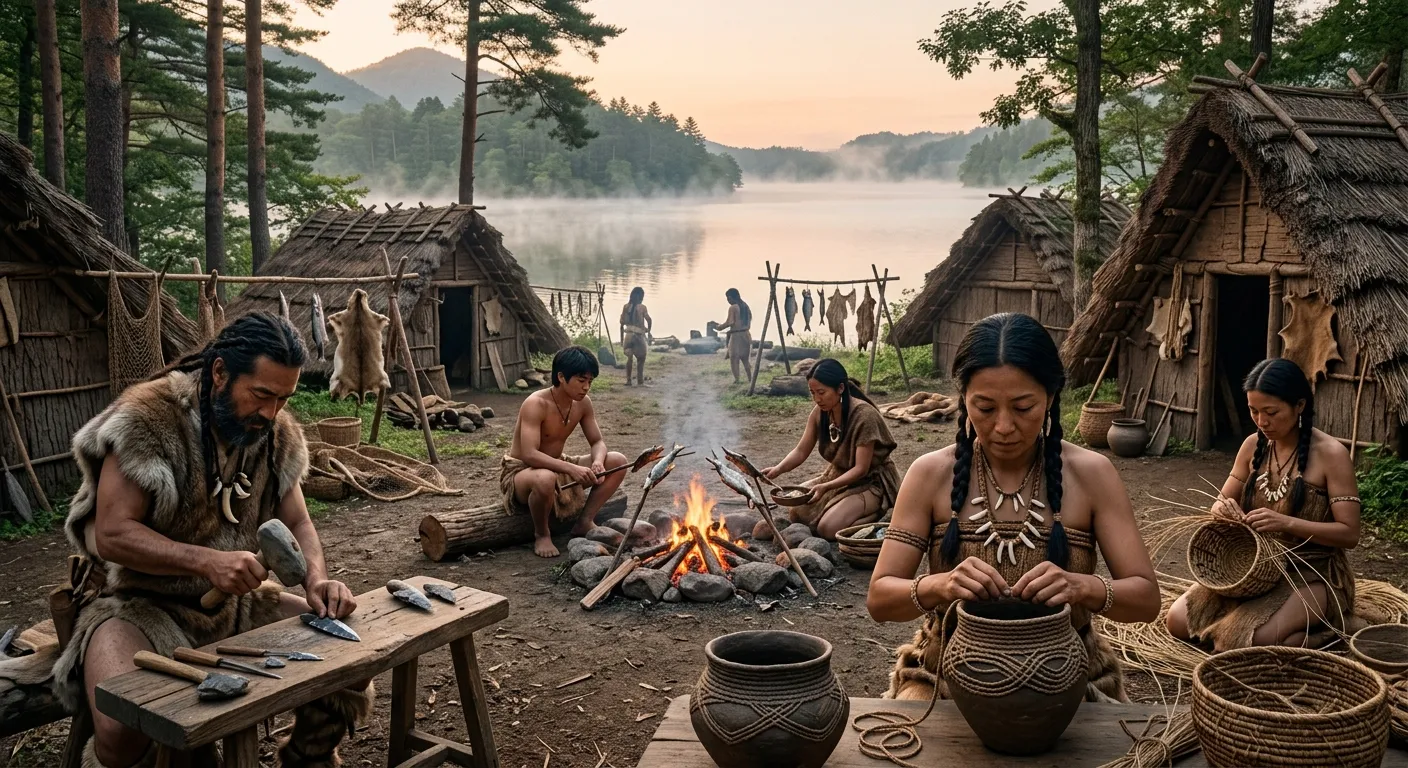
If you had stood here then, you would have heard the calls of migrating waterfowl, the wind rustling through broadleaf evergreen forests, and the soft splash of wooden paddles. If you looked closely at the lagoon's marshy fringes, you would have seen small groups of people in dugout wooden canoes, fishing and moving through a landscape where early rice cultivation was beginning to transform the Osaka Plain.
This is the story of Osaka's deep prehistory: a lost world of aquatic hunter-gatherers, incoming farmers, ancient exchange networks, and the gradual emergence of political power that would eventually make Naniwa one of the most important places in early Japan.
The Lost Waterworld of the Osaka Plain
To understand prehistoric Osaka, we must first understand its volatile geological foundations. Japan's archipelago is the product of immense, ongoing tectonic forces. The Kansai region lies within a highly active geological setting where mountain ranges and low-lying basins have developed over millions of years. The Osaka Basin is one such depression, bounded by major fault systems that continue to shape the region.
During the early Holocene epoch, around 6,000 BCE, rising global sea levels flooded Japan's low-lying coastal valleys. Sea water reached deep into the Osaka Basin, transforming much of what is now the Osaka Plain into a broad marine embayment. The Uemachi Plateau — the long, narrow ridge upon which Osaka Castle sits — stood above the surrounding lowlands as a prominent peninsula of higher ground.
As the centuries rolled on, the coastline changed. Sediment carried down from the surrounding mountains by rivers gradually built new land around the edges of the bay. By the Yayoi period, a growing sandbar and changing river courses had enclosed the eastern side of the bay, creating the brackish Old Kawachi Lagoon.
This was a dynamic, highly productive wetland ecosystem. Connected to the open waters of Osaka Bay by channels around the northern end of the Uemachi Plateau, the lagoon supported fish, eels, shellfish, waterfowl, and other resources. It was this watery landscape that became the setting for one of the most important cultural transitions in prehistoric Osaka.
Sumiwake: The Waterside Encounter of Jōmon and Yayoi
For thousands of years, the Japanese islands were inhabited by the Jōmon people. They were one of the world's most sophisticated hunter-gatherer-fisher societies. Far from being simple, nomadic foragers wandering through the forests, Jōmon communities lived in relatively stable settlements, mastered woodworking, produced some of the world's earliest pottery, managed useful plant resources, and developed highly complex seasonal lifeways adapted to their environments.
In western Japan, Jōmon populations were generally less dense than those in the richer forests of northeastern Japan. They relied on a comprehensive subsistence strategy that included gathering acorns and other nuts, hunting wild boar and sika deer, fishing, collecting shellfish, and exploiting the resources of inland lakes and coastal bays.
But during the late first millennium BCE, the region underwent a profound transformation. Farmers associated with the Mumun pottery tradition began moving from the southern Korean Peninsula into the Japanese archipelago, reaching northern Kyūshū and contributing to the emergence of what archaeologists recognize as the Yayoi culture. They brought new agricultural practices, including wet-rice cultivation, as well as metallurgy, weaving technologies, and other elements of continental material culture.
As these agricultural communities and their descendants expanded eastward through the Seto Inland Sea, they eventually reached the Osaka region.
What happened next was not simply a story of replacement. Archaeological evidence points instead to a prolonged period of interaction, coexistence, and cultural transformation sometimes described in Japanese archaeology as sumiwake, or habitat segregation.
On the Osaka Plain, this division was reflected in the landscape.
The Yayoi newcomers established farming settlements around the low-lying margins of the Old Kawachi Lagoon, where access to water and flat alluvial land provided favorable conditions for early rice cultivation.
Jōmon communities, meanwhile, continued to occupy higher ground around the basin, where their established lifeways — forest gathering, hunting, fishing, and the processing of wild plants — remained viable.
For perhaps 100–150 years, archaeological evidence suggests that communities associated with Jōmon and Yayoi lifeways existed alongside one another in the Osaka region. They were not isolated populations. Objects, technologies, food resources, and eventually people moved between them, as local communities adopted elements of the new agricultural way of life.
Imagine standing on the Uemachi Plateau and watching this ancient landscape unfold. Below you, on the calm, reed-lined waters of the Kawachi Lagoon, fishermen paddle between settlements. Along the shoreline, farmers tend small rice fields. Boats carry people, food, pottery, stone, and ideas between communities.
Over generations, this interaction transformed the local population. Agricultural lifeways spread, communities became increasingly integrated, and the descendants of Jōmon inhabitants and migrants from the continent became part of the populations that would eventually form ancient Japan.
The Sanukite Connection: Stone-Age Industry on Osaka Bay
The transformation of prehistoric Osaka was not an isolated local event. The region was connected to a much wider network spanning western Japan and the Seto Inland Sea.
Because the lowlands of the Osaka Plain offered few sources of high-quality stone suitable for making tools, prehistoric inhabitants looked beyond the immediate landscape for raw materials. One particularly important resource was a remarkable volcanic stone known as sanukite.
Sanukite is a fine-grained, high-silica andesite that fractures conchoidally, producing extremely sharp edges. It was particularly useful for producing stone axes, reaping knives, and other cutting tools.
The Osaka region was connected to the Sanuki area of northeastern Shikoku, through which agricultural technologies and large quantities of sanukite moved across the Seto Inland Sea. The movement of the stone provides a tangible reminder that prehistoric Osaka was already part of a regional system of exchange.
An even closer source was located on Osaka's doorstep: Mount Nijō, on the border between modern Osaka and Nara prefectures. Mount Nijō produced distinctive sanukite, and prehistoric artisans quarried the stone and distributed it widely across the surrounding region.
When you look at sophisticated stone tools recovered from local Yayoi sites — such as polished stone reaping knives used to slice ears of rice from their stalks — you are looking at evidence of a much wider network.
The Uemachi Plateau and the shores of the Kawachi Lagoon were places where raw materials, technologies, and ideas from Shikoku, Kyūshū, and the Asian mainland met and were transformed into a distinctive regional culture.
The Rise of Naniwa
By the beginning of the first millennium CE, the landscape of the Osaka Plain had undergone another profound transformation. The Old Kawachi Lagoon had gradually become shallower as sediment accumulated, creating an increasingly fertile lowland crossed by rivers and waterways.
At the same time, societies across the Japanese archipelago were becoming more socially stratified and politically organized. This was the Kofun period, the age of the great keyhole-shaped tombs (kofun) built for the emerging elite of the Yamato polity.
Osaka's waterways now became an enormous economic and transportation advantage.
By the fifth century CE, the same ridge that had once overlooked the prehistoric lagoon had become the site of an enormous complex of raised-floor warehouses at Hoenzaka on the Uemachi Plateau.
Excavations revealed a remarkable group of large wooden storehouses arranged in orderly rows. Their scale and organization distinguish them from ordinary village buildings. They were associated with Naniwa no Miyake, a royal or central establishment at Naniwa, and formed part of a system for storing and managing goods moving through Naniwa's growing port and its connections to the Inland Sea and the Korean Peninsula.
The choice of this location was no accident. The Uemachi Plateau offered high ground above the surrounding lowlands while sitting beside one of the most important waterways in western Japan. From here, people could manage goods arriving by land and water while avoiding many of the flooding problems of the surrounding plain.
The transformation is striking.
The same elevated ridge that had once provided Jōmon communities with a refuge above the lagoon had become a strategic platform for a society capable of concentrating enormous quantities of resources in monumental storage facilities.
And this was only the beginning.
Naniwa would go on to become one of the great political and commercial centers of early Japan. Palaces would rise on the same plateau. Emperors would rule here. Foreign envoys and merchants would arrive through its port. Centuries later, Toyotomi Hideyoshi would recognize the same strategic landscape and build his great castle upon it.
The castle was new.
The location was ancient.
Travel Tips: Where to Find Prehistoric Osaka Today
If you are planning a tour of Osaka Castle, you can easily turn your visit into a journey through deep prehistory. Here are the best places to experience this lost world:
-
The Naniwa Palace Site Park (Naniwa-no-Miya Ato)
Located just south of Osaka Castle Park, this open plaza preserves the archaeological landscape of ancient Naniwa. Stand here and look toward the castle keep: you are standing on the same elevated ridge that attracted rulers to this location for centuries.
-
The Osaka Museum of History
Situated beside the Naniwa Palace site, the museum provides a useful introduction to Osaka's prehistoric and ancient past, including Yayoi pottery, ancient wooden artifacts, stone tools, and the archaeology of the Naniwa region.
-
The Uemachi Plateau Walk
As you walk from the lower ground toward Osaka Castle, pay attention to the elevation change. You are following the natural spine of the ancient Uemachi peninsula, moving from the lowlands that once bordered the prehistoric lagoon onto the high ground that became one of the most important political locations in early Osaka.
When we look at Osaka Castle, we are looking at the tip of an immense historical iceberg. Beneath the dramatic stories of samurai generals and shogunates lies a deeper, older history — a history of people who learned to live, farm, trade, and flourish in a landscape of shifting water and changing shorelines.
The next time you visit, take a moment to look past the stone walls and imagine the quiet splash of a Jōmon canoe paddling home across the lagoon.
The castle is only the latest chapter.
Frequently Asked Questions
Where can I see the Naniwa Palace archaeological site in Osaka?
The Naniwa Palace Site Park (Naniwa-no-Miya Ato) is located just south of Osaka Castle Park. It preserves the archaeological landscape of ancient Naniwa, including the elevated ridge that attracted rulers to this location for centuries. Stand here and look toward the castle keep to experience the same strategic position that made Naniwa one of the most important political centers in early Japan.
Where can I learn about Osaka's prehistoric past?
The Osaka Museum of History, situated beside the Naniwa Palace site, provides a useful introduction to Osaka's prehistoric and ancient past, including Yayoi pottery, ancient wooden artifacts, stone tools, and the archaeology of the Naniwa region.
What is the Uemachi Plateau and why is it important?
The Uemachi Plateau is a long, narrow ridge in central Osaka upon which Osaka Castle sits. During the prehistoric period, it was a peninsula of higher ground overlooking the Old Kawachi Lagoon. As you walk from lower ground toward Osaka Castle, you are following the natural spine of the ancient Uemachi peninsula, moving from the lowlands that once bordered the prehistoric lagoon onto the high ground that became one of the most important political locations in early Osaka.