The History
Yes — but most visitors don't get a chance to see all the historical layers of it.
The current castle was rebuilt by the Tokugawa in the 1620s, built seven metres above the original Toyotomi castle designed in the 1580s. The Toyotomi castle sits on top of even older warrior monk fortrifications. The actual Osaka Castle museum inside the main tower is a solid introduction to the Sengoku period. But the real story of the site is underground and in the surrounding park, where four distinct archaeological layers span fifteen centuries within only 800 meters of each other.
Osaka Castle sits on the Uemachi Plateau — a narrow ridge that was, for fifteen centuries, the most strategically important piece of land in Japan. It controlled the port of Naniwa, Japan's gateway to the Asian mainland.
This is where Japan's first imperial capitals were built. Where the reforms that created the idea of a Japanese Emperor were engineered. Where warrior monks built a fortress that the most powerful warlord in Japan spent ten years failing to take. And where the last serious challenge to Tokugawa rule was extinguished in 1615.
After 1615, power moved permanently to Edo. Kyoto is where the Emperor lived for over a thousand years. Naniwa is where the idea of Empire was born.
The Summer Siege of 1615 ended with the fall of the Toyotomi clan and, according to the Tokugawa Shogunate, the suicide of Toyotomi Hideyori and his mother Yodo-dono inside the burning keep.
But recent evidence does not match the official Tokugawa account, no bodies were recovered and foreign eyewitness testimony contradicts the Shogunate's version of events.
The Tokugawa Shogunate said yes: an honourable death by suicide inside the burning keep. But no bodies were officially recovered.
The Tokugawa had every reason to declare him dead. Where and when Hideyori and his mother died is one of the many questions these tours investigate.
Toyotomi Hideyoshi (1537–1598) was the architect of Osaka Castle and the man who came closest to unifying Japan before the Tokugawa completed the task. Born to a peasant foot-soldier — a fact the historical record is unusually clear about — he rose through the ranks of Oda Nobunaga's army to become one of his most effective generals.
After Nobunaga's assassination in 1582, Hideyoshi moved faster than any rival to consolidate power. He built Osaka Castle between 1583 and 1597 on the ruins of Ishiyama Honganji — the fortress that had resisted Nobunaga for a decade. He launched two invasions of Korea. He ordered the death of the greatest tea master in Japan — Sen no Rikyū. He died in 1598 leaving a seven-year-old heir.
Yodo-dono (born as Chacha) was the mother of Toyotomi Hideyori and the most powerful woman in late 16th-century Japan. Born to Azai Nagamasa and Oichi — Oda Nobunaga's own sister — she came from high aristocratic lineage.
Before Osaka Castle, she had already watched two fortresses fall to war: Odani Castle in 1573, when she was approximately five years old, and Kitanosho Castle in 1583, when she was fifteen. Both times, she survived. History branded her emotional and irrational. The evidence suggests she was brilliant, dangerous, and inconvenient enough that the Tokugawa needed her erased.
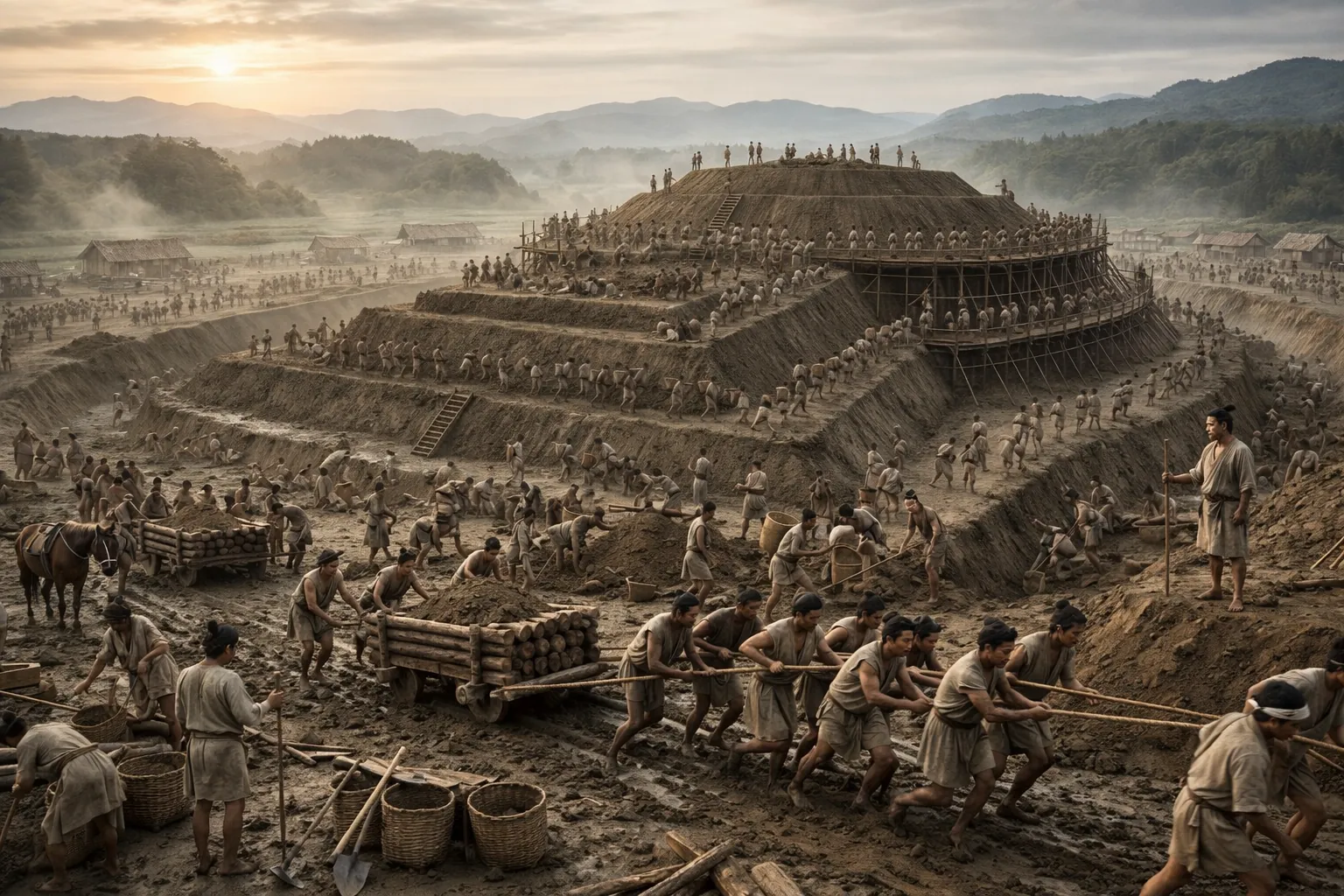
Ishiyama Hongan-ji was the fortress temple that stood on this ridge before Osaka Castle. Established by the Ikko-ikki warrior monk movement in the mid-16th century, it became the most defensible position in Japan — a fortress city protected on three sides by water and marshland, controlled by an institution with the loyalty of tens of thousands of armed adherents.
Oda Nobunaga spent ten years attempting to take it, blockading the port and cutting off supply lines. The Ikko-ikki held for a decade before a negotiated surrender in 1580. Toyotomi Hideyoshi built Osaka Castle on its foundations three years later. The Jesuit missionaries who saw both structures described Ishiyama Hongan-ji as the most formidable city in Japan. Its remains lie buried under the current castle park.
Naniwa Palace (Naniwa-no-Miya) was Japan's imperial capital in the 7th century — the palace complex built on this ridge following the Taika Reforms of 645 AD. It was the seat of the Japanese imperial court before Nara and before Kyoto.
The site was first excavated in 1954 and is preserved as an open archaeological park adjacent to Osaka Castle. Standing on its foundations, you are standing on the ground where the political framework that defined Japan for the next fourteen centuries was constructed — the concept of the Emperor as cosmic sovereign, the administrative state modelled on Tang Dynasty China, and the name Nihon itself.
In 1620, five years after defeating the Toyotomi at Osaka, the Tokugawa buried the Toyotomi castle under seven metres of fill and rebuilt Osaka Castle over it — the standard explanation being legacy erasure. The full story, including the 1950s rediscovery and the seven-metre excavation depth, is on the Osaka Castle history page.
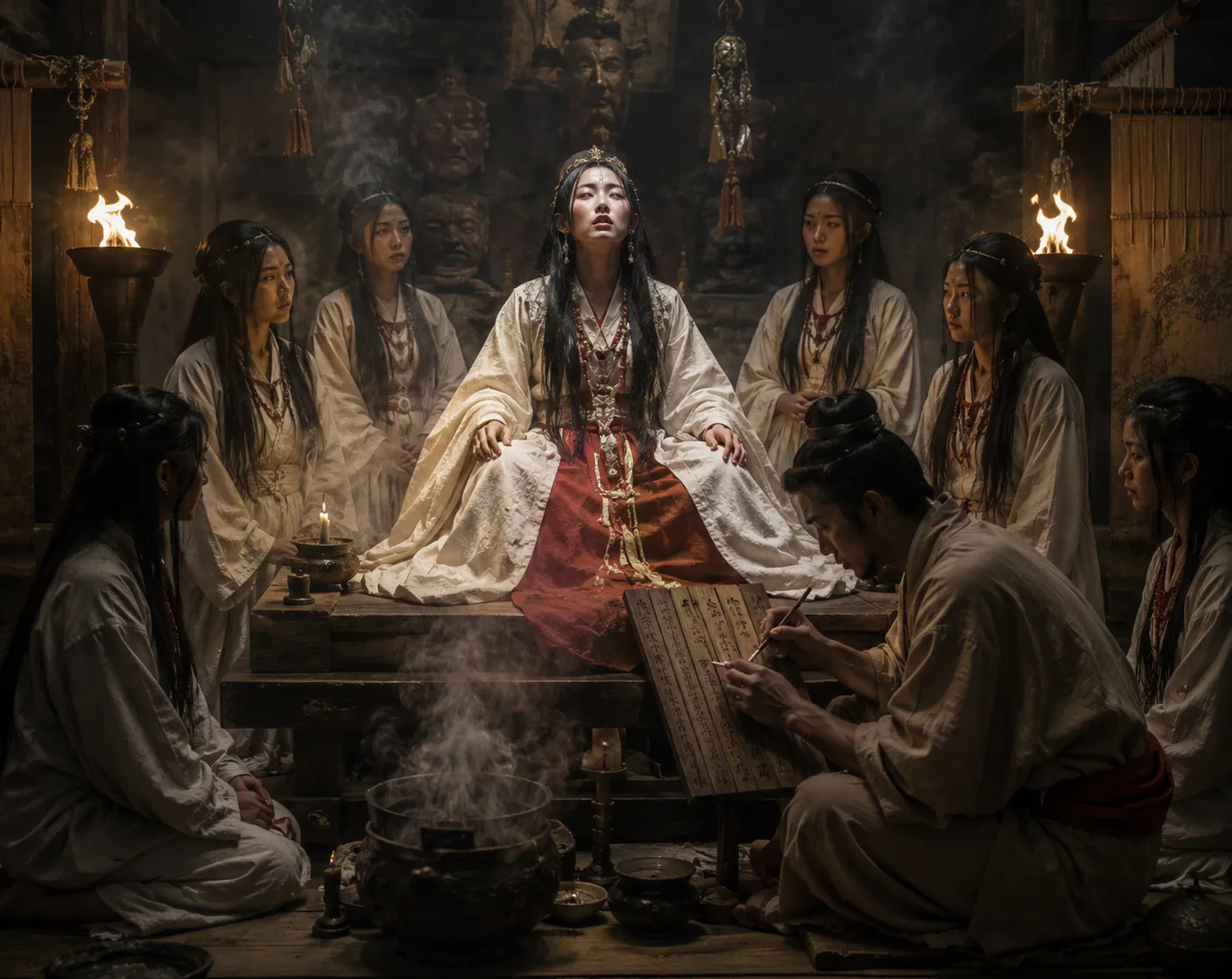
Himiko was the shaman-queen who ruled the confederacy of Wa — proto-Japan — around 200 AD, documented in the Chinese Wei Chronicle. She is the first named political figure in the territory we now call Japan. The full account is on the Yayoi timeline page.
The Tours
Most Osaka Castle tours follow the Toyotomi-Tokugawa narrative as the Tokugawa recorded it. These tours treat the same ground as forensic investigations: primary sources, physical evidence, and historical claims that remain genuinely contested.
The guide is a historian who lives beside the castle. Groups are capped at six guests. There is no script. Guests are presented with the facts as we know them and conclusions are yours to reach.
Start with the tour page — it compares all four routes against price, length, and focus so you can pick the one that matches what brought you to Osaka.
Yes. Groups are capped at six guests and the pace is relaxed, so solo travelers and couples get a personal, conversational experience with a resident historian rather than a large-bus tour. Solo travelers and couples consistently rate these among the best Osaka Castle history tours in Osaka.
For history lovers wanting the full sweep, start with Before Japan Had a Name — it covers 7,000 years from the first settlements to the fall of the castle. For families and younger guests, each tour covers less than one kilometer of walking and passes the castle's famous landmarks; the Warrior Monks tour's dramatic stories of warlords and sieges are usually the biggest hit with younger travelers.
Maximum six guests per tour. This is not a large-group experience.
Yes. Osaka's history is far too complex to tell in only 2.5 hours. Therefore, the three tours cover different mysteries and contraversies that occured on the same ground. Each tour is self-contained — you do not need to take them in sequence — but guests who take two or three frequently say the context compounds. The ground stays the same. The story deepens.
Each tour includes GPS-enabled historical maps and visual overlays, guided analysis of the archaeological landscape, and a post-tour companion — a detailed reference document with historical reconstructions, photographs from the walk, and academic source citations, delivered within two hours of the tour's end.
Food, drink, and transport to the meeting point are not included.
We walk rain or shine. Osaka’s history is dramatic in any weather! I can provide umbrellas if needed. In case of extreme weather alerts, I will contact you directly to make alternative arrangements.
Changes & Cancellations: You can cancel or reschedule for a full refund up to 24 hours before our scheduled start time. Cancellations made within 24 hours of the tour are non-refundable.
Running Late? Please don't panic—navigating a new city can be tricky! If you are running behind, just send me a quick message to let me know. I will send you a Google Map pin drop so you can catch up to us on the route. (Note: If I don't hear from you at all within 30 minutes of our start time, we will have to treat it as a cancellation to respect the rest of the day's schedule.)
Unexpected Travel Snags: If your flight is delayed or plans change last minute, please reach out as soon as possible. While refunds are not possible within the 24-hour window, I will always do my absolute best to help you reschedule to another day if my calendar allows.
Getting Here
All tours start near Tanimachi 4-chome station, a short walk from the castle. Full meeting-point details and directions are on the tour page.
Take the Osaka Metro Tanimachi Line or Chuo Line to Tanimachi 4-chome Station. The meeting point is a 90-second walk from Exit 1A.
Comfortable walking shoes. The route is flat and mostly paved, but you will be standing for extended periods. In summer, a hat and water are strongly recommended — the castle park offers limited shade. There are many vending machines and washrooms as well as a limited number of smoking areas are located throughout the park.
The tours are designed for adults and older teenagers with a genuine interest in history — the walk is outdoors for the full 2.5 hours and the content is detailed. The full guidance, including what works for families, is on the Osaka Castle with kids page.
The castle park is worth visiting year-round — cherry blossoms draw the biggest crowds, winter has the clearest light, and autumn has the best colour. The month-by-month breakdown is on the best time to visit page.
The castle park and most of the archaeological sites are free to enter. The castle museum inside the main tower charges an admission fee of ¥1200 per person (includes the new Stone Wall Museum enterance). Museum entry is not included in the tour price but can be arranged — ask when booking.
Yes. For schools and universities, the same historian runs Osaka History Investigations — curriculum-aligned field investigations at Osaka Castle for junior high, high school, and university students, in English or Japanese.
Yes. For companies, there is corporate team building — a private facilitated session in and around Osaka Castle Park built on three real historical dilemmas. Teams of 10–40 investigate, debate, decide, and vote.