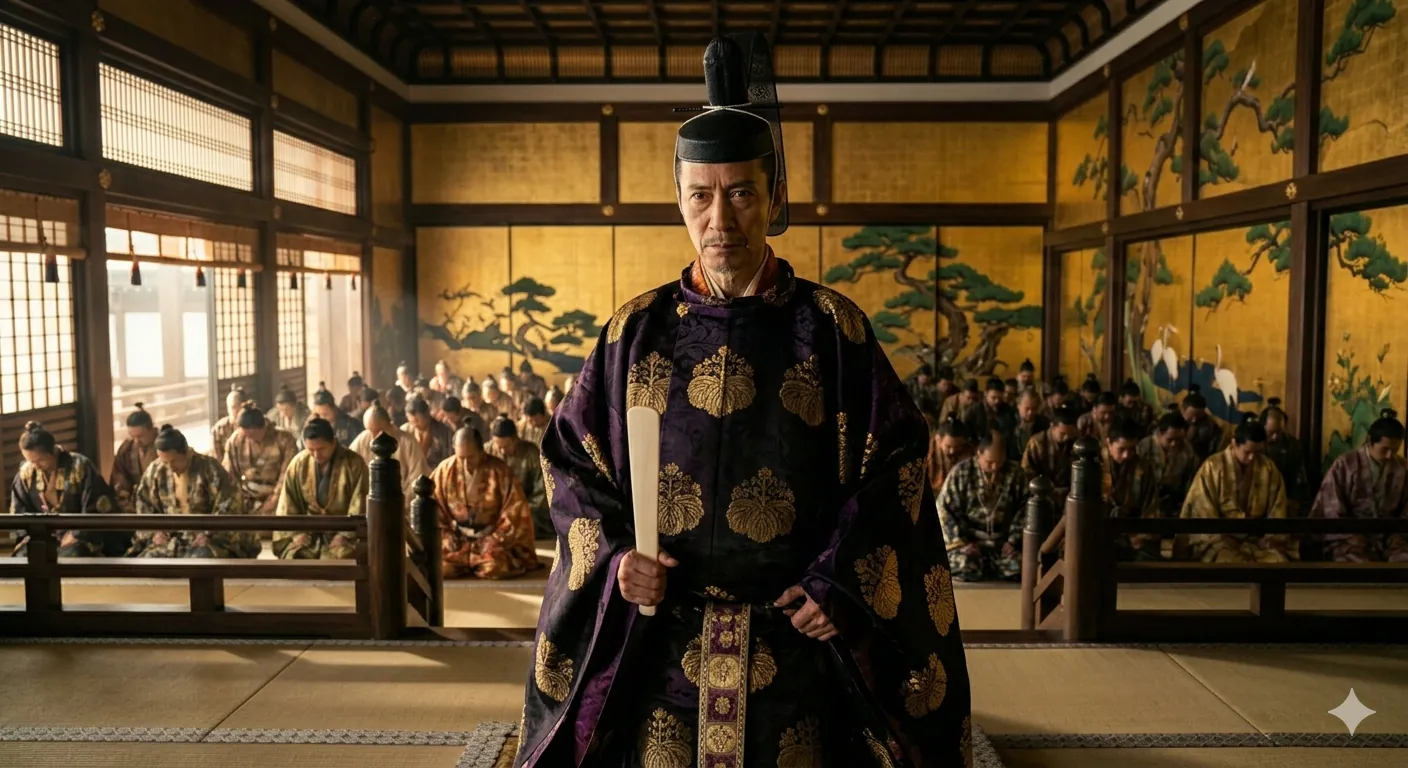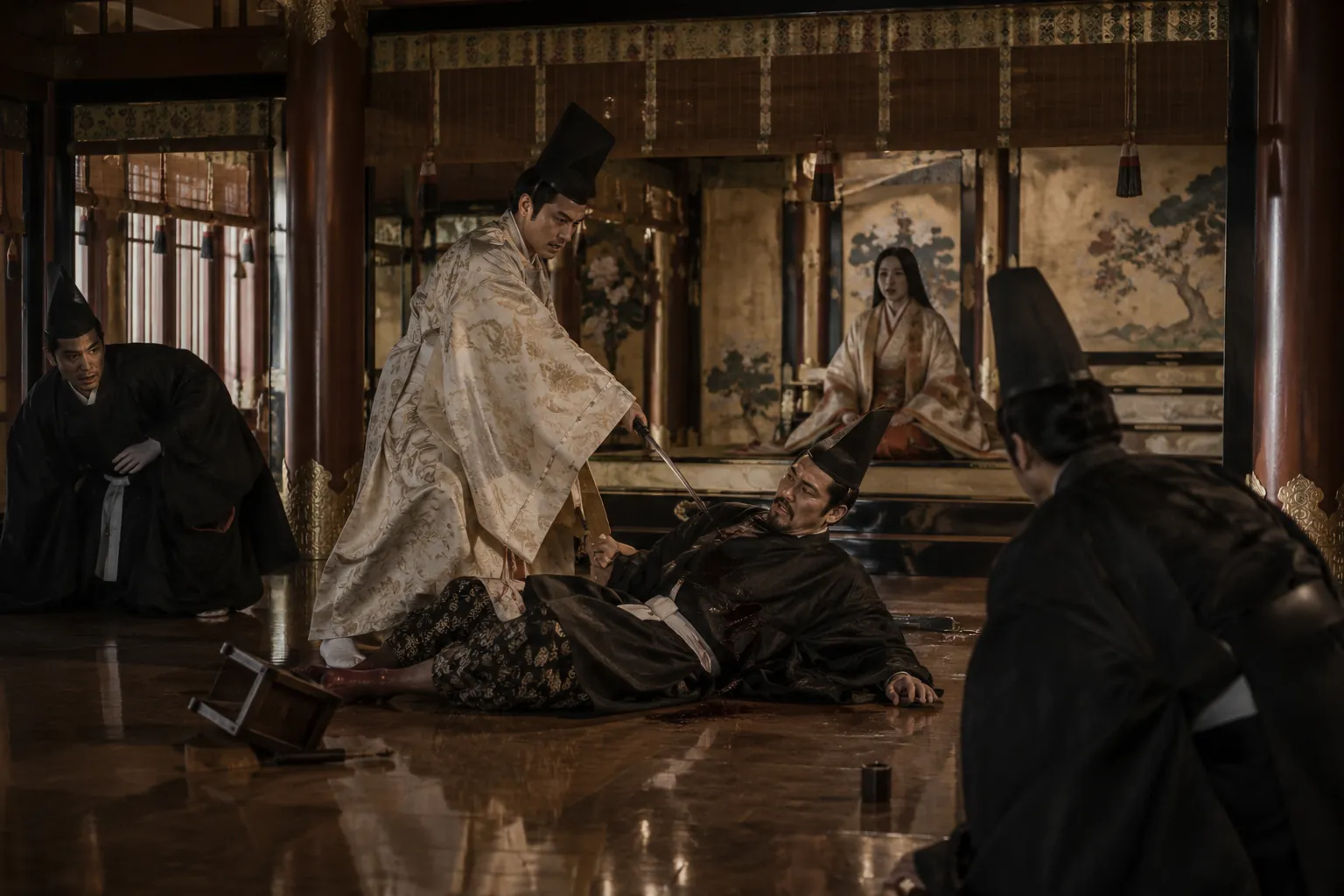
According to scholars, in the year 645, the Empress was seated on the throne. A formal imperial proclamation from one of the Three Kingdoms was being read aloud to her by a court official, with the rigid ceremony such an occasion demanded. Soga no Iruka — the highest minister in the realm — stood before the throne in silence, unarmed, receiving the proclamation symbolically, as he had done many times before. The hall was perfectly ordered: courtiers arranged by rank, guards at the perimeter, every movement governed by protocol.
Unbeknownst to Iruka, the palace gates had been locked, guards bribed, and weapons hidden inside the hall. The assassins were not soldiers. They were courtiers — men who had never killed anything in their lives. At the appointed moment, all four would-be assassins hesitated. Iruka sensed something was wrong.
Prince Naka no Ōe, realizing the plot was collapsing, drew one of the hidden weapons, rushed forward, and struck Iruka across the head and shoulder — a deep, devastating blow that left him bleeding heavily but still conscious. Staggering, shocked, and in unbelievable pain, Iruka protested his innocence directly to the Empress.
Although the Empress remained seated as the attack and subsequent pleas for mercy unfolded, everyone in the room was visibly stunned. The court was witnessing a violation of ritual so obscene it constituted spiritual pollution. Court attendants moved quickly to shield the Empress and usher her out of the throne room. After a few more seconds of silence, the co-conspirators rushed toward Soga no Iruka seemingly in unison and dispatched him — in a way only men completely untrained in the art of death would do.
According to chroniclers, the planning of this assassination is attributed to one man: Nakatomi no Kamatari — who, twenty-four years later, in 669, was granted a new family name by Emperor Tenji for his part in orchestrating the assassination. That name, that new political voice, was Fujiwara.
This scene may sound like pure invention, the kind of ornate conspiracy only science fiction could produce. It isn't. Over a thousand years before Frank Herbert's masterpiece, the Fujiwara clan rose to power as regents to the Japanese imperial throne. Japan's Fujiwara never seized the Chrysanthemum Throne. They did something the Bene Gesserit Sisterhood would have recognized instantly: they made the throne need them, generation after generation. For more than five centuries the Fujiwara shaped Japan's politics; for over fourteen hundred years they shaped the imperial bloodline — and ultimately built a court culture tradition that outlasted both.
“We are not concerned with who sits on the throne, but with who shapes the mind of the one who sits on it.”
— Dune, Princess Irulan
Convergent Evolution
When unrelated organisms encounter similar pressures, evolution can arrive at remarkably similar solutions. Ichthyosaurs and dolphins, for example, evolved in entirely different branches of the animal kingdom, separated by hundreds of millions of years. Yet both descended from land creatures that returned to the sea—developing streamlined bodies, dorsal fins, and flipper-like limbs because open water rewarded the exact same adaptations.
Biologists call this convergent evolution.
Two Institutions, One Constraint
In Japan, imperial authority was anchored in a patrilineal line tracing back to the sun goddess Amaterasu. The emperor was not a strongman holding a country together by force but rather the earthly representative of a divine lineage. The Fujiwara had no standing army. Even if they had seized the throne, it would have meant severing sacred continuity and exposing their chosen leader as a usurper. In Herbert's Imperium, the Bene Gesserit hit the same wall: the Sisterhood had no house army and no blood claim to the Golden Lion Throne. Imperial legitimacy flowed strictly through House lineage and marriage, policed by the Landsraad. Even Paul Atreides, after crushing House Corrino outright, still had to marry Princess Irulan to make his claim — proof that individual emperors were replaceable, but the institution of royal blood was not.
Neither the Fujiwara nor the Bene Gesserit could take power directly. Neither possessed the raw force required to seize and maintain control. So both engineered an alternative: control the conditions under which power was inherited. Let the sovereign absorb the ceremony, the scrutiny, and the target on his back, while influencing the marital and administrative machinery from behind the throne. Power wasn't seized. It was grown, through decades of unbroken proximity.
The scale of both programs is remarkable. In Dune, the Bene Gesserit's Truthsayers guided government policy and managed genetic pairings for thousands of years. Following the Soga assassination, the Fujiwara clan dominated the sesshō and kampaku regency and exerted enormous influence over the kugyō — the senior council of state — meaning the machinery of Japanese government was, for centuries, controlled through Fujiwara hands, directly or through their allies. From the mid-9th century on, the maternal line to Japan's throne ran primarily through Fujiwara women. Sixty-one of eighty-nine Japanese emperors were born to Fujiwara mothers over the course of 1,344 years.
“She could wait with her sisters — ninety generations for the proper combination.”
— Dune, Reverend Mother Mohiam
A Breeding Program in Blood and Court Ritual
The Bene Gesserit weren't founded out of vanity. They were forged in the aftermath of the Butlerian Jihad, staring at a galaxy that had outlawed thinking machines and now had nothing but unguided human genetics to work with. Left to chance, the Great Houses would drift, stagnate, and eventually produce nothing useful at all. Their answer was a long-term breeding program, run from inside royal households by Truthsayers, concubines, and advisors — human destiny steered from the shadows, never from the throne.
The Fujiwara arrived at something similar through a bloody education: court massacres, failed coups, and the study of what happened when others tried to usurp the throne.
In 592, Soga no Umako arranged the assassination of Emperor Sushun — the only confirmed case of a subject killing a reigning Japanese sovereign. It worked, for a while. The coup against his descendant Iruka, the one that opened this essay, settled the account. For Kamatari — the Fujiwara clan founder — and for the descendants who took his name, the lesson was written in Soga blood: never mistake influence over the sovereign for sovereignty itself.
The Fujiwara were also heirs to a political culture steeped in Chinese history, which offered stark warnings about waiqi— consort clans who married into the imperial family and then tried to become the imperial family. Empress Lü's relatives, purged after her death in 180 BC, and Wang Mang, who usurped the Han throne in 9 AD only to be killed fourteen years later — both were object lessons in what happens when a family forgets it is supposed to stay in the shadow of the throne, not on it.
In all the centuries they influenced imperial politics, only once would the Fujiwara test that lesson. In 764, Fujiwara no Nakamaro led a coup attempt against Empress Shōtoku, trying to preserve the position of Shōtoku's adopted son, sitting Emperor Junnin. The plan failed. Nakamaro was killed, Emperor Junnin was exiled to Awaji, and the Fujiwara's political dominance suffered a generational setback. A severe reminder—never mistake influence over the sovereign for sovereignty itself.
“We are Bene Gesserit. We don't hope, we plan.”
— Reverend Mother Mohiam, Dune: Part Two
The Full Moon
Institutions that think in centuries develop a very specific kind of confidence. Reverend Mother Mohiam names it plainly in Dune: Part Two:
Fujiwara no Michinaga stood at the peak of that same confidence. By 1018, three of his daughters were empress simultaneously — a feat the court had never seen before and would never see again — and he would go on to see three of his grandsons reign one after another. At a moonlit banquet that year, he is said to have composed what's now called the Mochizuki no uta:
この世をば わが世とぞ思ふ 望月の
欠けたることも なしと思へば
“This world — I feel it is truly mine; like the full moon, it lacks nothing.”
Whether it was boast or self-awareness is still debated. Either way, both institutions believed, at their respective peaks, that they had built a machine so complete it had turned time into a weapon.
When Shadow Architecture Meets the Unmanageable
But no system, no matter how elegantly designed, lasts forever.
“The power to destroy a thing is the absolute control over it.”
— Paul Atreides, Dune
The Fujiwara had spent centuries operating as though political reality were defined entirely by Kyoto court politics: bloodlines, maternal influence, ritual precedence, and administrative maneuver. At their height, the assumption was difficult to dispute. If you controlled access to the throne, you controlled the state.
The Bene Gesserit harbored the same confidence. They believed that through genetic management, religious engineering, and political access, they had mapped every variable of human power. They believed that no matter who sat on the Golden Lion Throne, the levers behind it would always belong to them.
Both institutions were wrong for the same reason: shadow architectures only function as long as everyone agrees to play by the same rules. Their systems didn't fail from weakness. They failed because an unmanageable force entered the world they had painstakingly engineered. For the Fujiwara, the end did not come from a rival court faction playing the same game better. A spark triggered evolution within the system itself — before exploding.
Beginning in the late eleventh century, retired emperors increasingly exercised political authority from cloistered courts after leaving the throne. Shirakawa, Toba, and Go-Shirakawa did not need to overthrow the Fujiwara or abolish the imperial institution. They simply created another center of power around it. The Fujiwara had perfected the art of controlling the emperor who occupied the throne; insei demonstrated that political power could reside somewhere else.
Beyond the refined, poetry-reciting halls of Heian-kyō, a new class of actors, partially funded by those same retired emperors, had been quietly accumulating the one currency court politics could not manipulate: physical violence. When the provincial military networks of the Taira and Minamoto clans realized that armed samurai cavalry mattered more than court rank, the Fujiwara's centuries of political engineering were rendered obsolete. By the time the Kamakura Shogunate established its military government in 1185, the imperial court wasn't destroyed — it was bypassed. The shadow masters were left holding the levers of a machine that no longer drove the empire.
In Dune, the Sisterhood's displacement follows a similar curve. The Bene Gesserit spent generations engineering a controlled Kwisatz Haderach and seeding prophecies through the Missionaria Protectiva, confident they could harvest those myths whenever necessary. They did not anticipate Paul Atreides weaponizing the Fremen — a martial, fanatical force from a desert world on the edge of the Imperium that cared nothing for Landsraad protocol or Great House marriages. Paul didn't outmaneuver the Bene Gesserit at their own game; he introduced a force that existed outside their influence, pushing the Sisterhood to the margins of the very universe they had engineered.
When the dust settled in both Kyoto and Arrakis, the sacral sovereigns remained on their thrones — but the shadow masters who built their power on the illusion of permanent control learned a brutal lesson:
History doesn't topple shadow governments — it bypasses them.
Frequently Asked Questions
How did the Fujiwara control Japan without ever becoming emperor?
The Fujiwara had no standing army and no blood claim to the throne, so they controlled the conditions under which power was inherited instead: marrying their daughters into the imperial line, raising emperors as grandsons, and holding the regency offices of sesshō and kampaku. From the mid-9th century on the maternal line to the throne ran primarily through Fujiwara women — 61 of 89 emperors over 1,344 years — while Fujiwara regents managed the government from behind the throne.
What was the Isshi Incident of 645?
The Isshi Incident was a palace coup on 645 in which Prince Naka no Ōe and Nakatomi no Kamatari killed Soga no Iruka, the highest minister in the realm, before the seated Empress during a formal court ceremony. The assassins were unarmed courtiers who hesitated; the prince himself drew a hidden weapon and struck the first blow. Kamatari's reward, granted in 669, was a new family name from Emperor Tenji: Fujiwara.
How are the Fujiwara like Dune's Bene Gesserit?
Both were shadow institutions that could not take power directly: no army, no blood claim to the throne. Both engineered the alternative of controlling inheritance itself — the Bene Gesserit through a millennia-long breeding program, Truthsayers, and marriages arranged for the Golden Lion Throne; the Fujiwara through consort marriages, regency offices, and maternal descent. Both also failed the same way: an unmanageable force entered their engineered systems — the Fremen for the Sisterhood, retired emperors and samurai for the Fujiwara — and history bypassed them rather than toppling them.
How many Japanese emperors had Fujiwara mothers?
Sixty-one of eighty-nine Japanese emperors were born to Fujiwara mothers over the course of 1,344 years. From the mid-9th century the maternal line to the Chrysanthemum Throne ran primarily through Fujiwara women, and at the clan's peak Fujiwara no Michinaga had three daughters who were empress simultaneously in 1018.
Why didn't the Fujiwara just seize the throne?
Imperial legitimacy was a sacred patrilineal line tracing back to the sun goddess Amaterasu. Seizing the throne would have severed that sacred continuity and exposed the usurper as illegitimate — and the Fujiwara had no army to hold power by force. Only once, in the failed 764 coup of Fujiwara no Nakamaro, did the clan test that lesson, and the setback lasted a generation.
What ended Fujiwara dominance?
Two forces bypassed the regency rather than overthrowing it. Beginning in the late 11th century, retired emperors ruled from cloistered courts (insei), creating a center of power the Fujiwara did not control. Beyond Kyoto, provincial military networks under the Taira and Minamoto clans accumulated the one currency court politics could not manipulate: armed samurai. By the time the Kamakura Shogunate was established in 1185, the imperial court was not destroyed — it was bypassed, and the shadow masters were left holding the levers of a machine that no longer drove the empire.