I went to the Osaka Museum of Oriental Ceramics in the fall of 2025 because I wanted to better understand Osaka Castle, Toyotomi Hideyoshi and an often-overlooked aspect of Japan’s Warring States period (1467–1615)—not the armour or the battles, but the quieter, older currents that shaped their culture.
I was there to see a National Treasure. Instead, I found myself contemplating five words:
Formerly owned by Toyotomi Hidetsugu.
1595: The Sanjō Riverbed
On September 5, 1595, thirty-nine people from Toyotomi Hidetsugu’s household were taken to the Sanjō Riverbed in Kyoto and executed. Most were women and children: wives, concubines, attendants and young members of the household. Among them was Komahime, the daughter of Mogami Yoshiaki, the powerful lord of Dewa, who was fifteen years old by traditional Japanese age reckoning. She had arrived in Kyoto in late June or early July to become Hidetsugu’s concubine. She would be dead before summer’s end—and according to the traditional account, had not yet even met Hidetsugu.
Sixteen days before her execution, Hidetsugu himself had been forced to die on Mount Kōya. Hideyoshi did not stop with his nephew. The great Jurakudai residence in Kyoto, from which Hidetsugu had exercised power as kanpaku, was dismantled. A political world was being physically erased along with the man at its centre.
Hidetsugu was destroyed. Komahime and thirty-eight others were gone.
The bowl was not.
Five Words on a Card
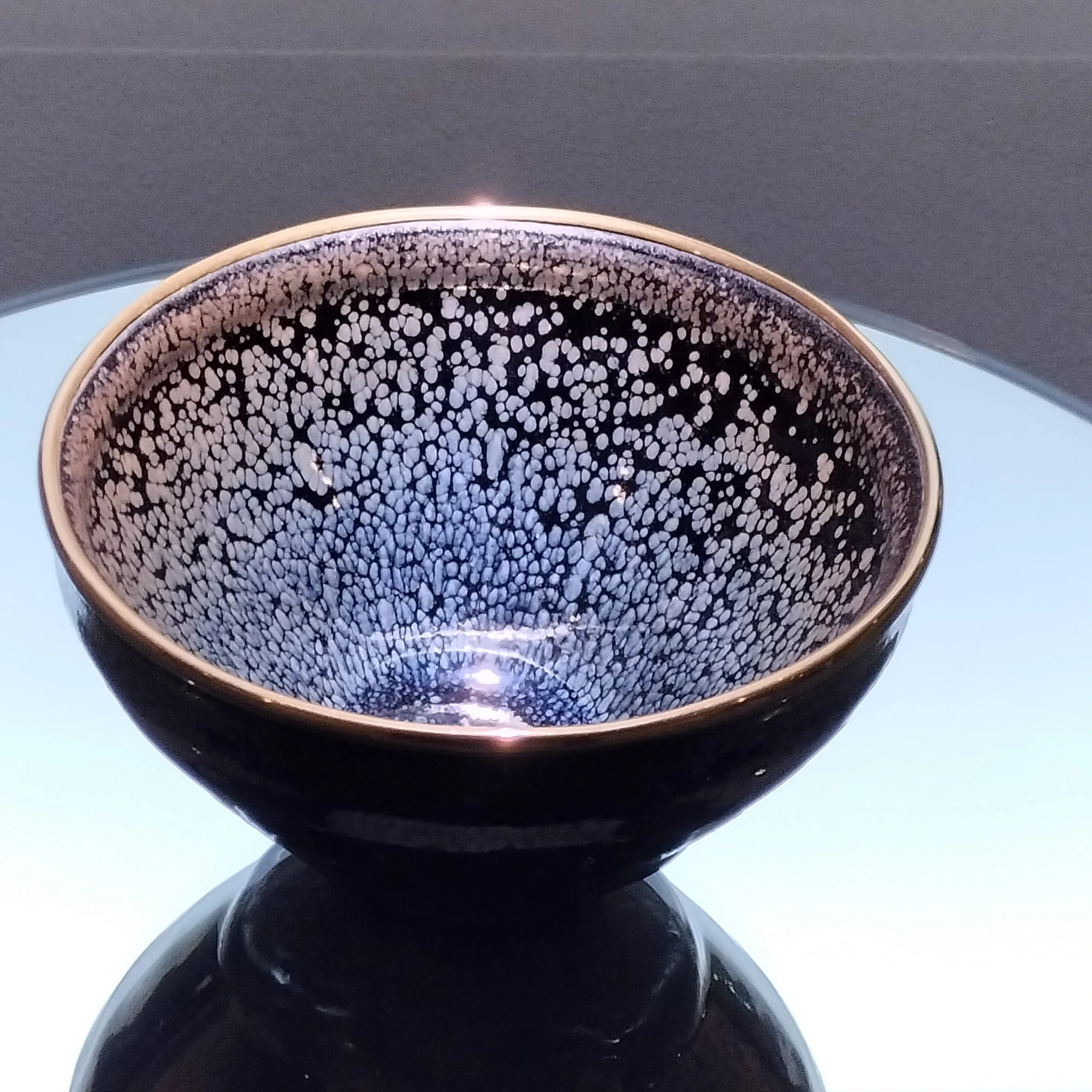
It is small enough to hold comfortably in two hands and weighs 349 grams. Its black, iron-rich glaze is covered with shimmering silver yuteki, or “oil-drop”, markings that catch the light with hints of blue, violet and gold. A narrow band of gold has been added around its fragile lip.
I stood looking at it for several minutes.
Then I read the card.
Yuteki Tenmoku Tea Bowl
Southern Song dynasty, 12th–13th century
Formerly owned by Toyotomi Hidetsugu
National Treasure
My wife was beside me, taking photographs of the bowl—photography is allowed, and even encouraged, in the museum. Mesmerized by the glaze I said, “Oh my God. This 800-year-old bowl looks like it came out of the kiln yesterday… Do you know why it’s famous?”
We were alone in the display room, so I felt like I could tell her the whole, unvarnished story of the massacre.
When I finished, she said nothing. Her face clouded with a quiet, uncomfortable silence.
We stood quietly in contemplation for another couple of minutes before we moved on.
Although I meant well, the whole interaction bothered me. Had I enlightened her, or just ruined not only the experience but her perception of Hideyoshi?
Here was an exquisite object, quietly displayed in an elegant art museum, and beside it a five-word reference to one of the bloodiest episodes in the history of the Toyotomi regime:
Formerly owned by Toyotomi Hidetsugu.
Are these five words inadequate?
That question has become increasingly difficult for museums around the world, as institutions face growing demands to confront the uncomfortable histories attached to their collections.
I wanted to learn more.
The Curator’s Honest Answer
So, I arranged a meeting and went back to the museum to interview a person who knows this object intimately.
Hitoshi Kobayashi is the chief curator of the Museum of Oriental Ceramics, Osaka, and Tenmoku is his field of research. We met in a large boardroom at a table built to seat fifteen or twenty people. He had prepared for my arrival, laying out a neat stack of photocopied documents he thought would answer the questions I had sent him in advance, alongside a couple of books on Tenmoku.
I expected the absolute certainty of an expert.
What I did not expect was how often his answer to my questions would be:
“Not sure.”
I asked how confidently we could trust the bowl’s provenance. Kobayashi-san clarified the established tradition tracing it from Hidetsugu to Nishi Honganji, then through the Sakai family of Wakasa, before it entered the renowned Ataka Collection and eventually became part of the collection of the City of Osaka.
But when I probed further about provenance before Hidetsugu, Kobayashi-san’s answer was very candid.
“Not sure,” he said, smiling.
Kobayashi explained that Japanese provenance documents can sometimes mix history and mythology, and that the surviving document is accepted by most scholars because there is no way to disprove it and no good reason to dispute it.
That answer was more interesting to me than a confident declaration would have been.
A museum label has to be concise and decisive, but historical evidence often isn’t. The past comes down to us in damaged layers, and Kobayashi-san cannot recover what history has lost.
The more we talked, the more the bowl itself began to seem like a physical record of that problem.
Raw Thermodynamics
It was made in China during the Southern Song dynasty at the Jian Dragon kilns of Fujian, its remarkable surface created through the interaction of iron-rich glaze and extreme thermal conditions.
When Kobayashi-san spoke about the kilns, his demeanor shifted to one of quiet, absolute confidence. The magic of the bowl wasn’t a mythical, secret recipe; it was raw thermodynamics.
“Basically, the recipe is not so different. It’s the same recipe. Just the difference of firing, atmosphere, oxygen and cooling speed.”
He explained the staggering, unglamorous scale of the ancient industry. One firing could produce tens of thousands of pieces, perhaps more than half of which would fail to fire properly. Where a piece was positioned inside the massive kiln mattered enormously. Only highly specific conditions inside the kiln could produce the spectacular effects that later became so prized in Japan, which made these bowls exceptionally rare.
How Much Light Should We Put on History?
Our conversation shifted to museum aesthetics; some use a darkened room and focussed light to create a sense of drama. In sharp contrast, Kobayashi-san explained the Osaka Museum of Oriental Ceramics features the world’s only ‘natural light’ display. It is a curatorial choice. Highly controlled lighting is used to accentuate the bowl’s unique oil-drop pattern.
The focus on lighting made something clear to me.
The museum is actively translating the object. It is taking something made in another time, in another culture, and deciding how a modern visitor should experience it.
That is neither praise nor criticism; it is unavoidable.
We cannot return to the world in which it was made. We can only decide how to present what remains.
But it raises the question: How much light should we put on history?
Too little, and we risk sanitising it; too much, and the object can disappear beneath an explanation of everything that has ever happened around it.
The curator’s job is not to know everything, but to know where the limits of knowledge are.
Kobayashi also explained something I had not fully appreciated when I first saw the card. The museum had deliberately reduced the amount of text on its captions. What had once been around 300 characters had been reduced to around 150. The captions must accommodate both Japanese and English, while remaining large enough for an audience that includes many older visitors.
“Our caption is due to space. Just very simple,” Kobayashi-san said, explaining that extended histories belong on website databases, digital guides, and exhibition panels, where visitors can dive as deep as they choose.
He also pointed out a fundamental distinction I had overlooked: the Museum of Oriental Ceramics is, first and foremost, an art museum, not a history museum. Its primary mission is aesthetic contemplation—allowing the object to speak through form, light, and craft rather than heavy narrative text.
A label, in other words, is not the history of an object. It is an entry point.
The museum preserves the object and gives the visitor the best context it can within the limits of space. The visitor brings the curiosity and willingness to ask what lies beyond the lines on the card.
This Tenmoku is important because it can tell us about Chinese technology, Buddhist exchange, the culture of the warrior elite, and the political value of art.
Its complicated history does not make it less worthy of display.
It makes it more worthy of understanding.
The 1595 massacre does not define the bowl, nor does the label fully capture it. Its value lies precisely in that tension—a single object sitting at the intersection of master craftsmanship, spiritual culture, and political ambition.
When the museum reopens in 2027, the Tenmoku will be back in its case. The room’s lighting will be carefully controlled, and the label will still read: Formerly owned by Toyotomi Hidetsugu.
Frequently Asked Questions
What does the label "Formerly owned by Toyotomi Hidetsugu" mean?
It is the museum’s five-word caption on the Yuteki Tenmoku, a National Treasure tea bowl at the Osaka Museum of Oriental Ceramics, Osaka. It records the traditional account that the bowl was among Toyotomi Hidetsugu’s tea utensils at the Jurakudai palace in Kyoto — the starting point of a provenance chain that runs through Nishi Honganji temple and the Sakai family of Wakasa into the Ataka Collection, now held by the City of Osaka.
Who was Toyotomi Hidetsugu, and what happened in 1595?
Hidetsugu was Toyotomi Hideyoshi’s nephew and served as kanpaku (regent) from the Jurakudai palace in Kyoto. In 1595 Hideyoshi forced him to die on Mount Kōya and dismantled his residence; sixteen days later, on September 5, thirty-nine members of his household — mostly women and children, including the fifteen-year-old Komahime — were executed at the Sanjō riverbed in Kyoto.
Can the museum prove the bowl belonged to Hidetsugu?
Not with certainty. Chief curator Hitoshi Kobayashi describes the provenance as “non-provable”: the traditional account survives in a single document that scholars can neither confirm nor disprove, because Japanese provenance records can mix story with history. The museum treats the label as the accepted tradition, not a proven fact.
Why is the museum label so short?
The captions were reduced from around 300 characters to around 150 so they can carry both Japanese and English while staying legible to older visitors. Kobayashi-san also notes the museum is an art museum first: extended histories belong on databases, digital guides and exhibition panels — the label is an entry point, not the full story.
When will the Yuteki Tenmoku be on display again?
The museum reopens in 2027; the essay closes with the Tenmoku back in its case, its five-word label unchanged.